The Evolution of Authority in Modern Search

Authority evaluation has shifted significantly as search systems have matured beyond simple relevance matching and link-based signals. To understand how search engines evaluate authority, examine how trust indicators in modern search systems, structural authority, and modern SEO authority signals interact across entire domains rather than isolated pages. Increasingly, assessment happens at the domain level through pattern recognition and the coherence of content ecosystems over time.
Tactical optimization alone is no longer enough to establish authority. Topical authority, consistent search intent alignment, and editorial consistency now play a central role in trust accumulation and ranking durability. As non-link authority indicators become more prominent, sustained alignment between content structure, intent fulfillment, and long-term reliability determines stability.
The Era of Tactical Authority
Early search systems evaluated authority through relatively narrow and tactical signals. Page-level optimization, keyword placement, and backlink acquisition were often sufficient to establish competitive visibility. Authority functioned as a measurable outcome of discrete actions rather than a reflection of broader structural alignment across a domain.
Why Isolated Optimization Stopped Scaling
As search systems matured, isolated optimization began to lose scalability. Advances in pattern recognition allowed engines to assess signals extending beyond backlinks and surface-level keyword alignment. Pages were no longer treated as independent units. Instead, systems examined how content functioned collectively across a domain.
The Shift from Page-Level Wins to Domain-Level Evaluation
Authority assessment has moved from evaluating individual documents to analyzing entire domains as interconnected systems. To understand how search engines evaluate authority, recognize that page-level performance is increasingly interpreted within a broader structural context.

Intent Alignment as a Core Authority Signal
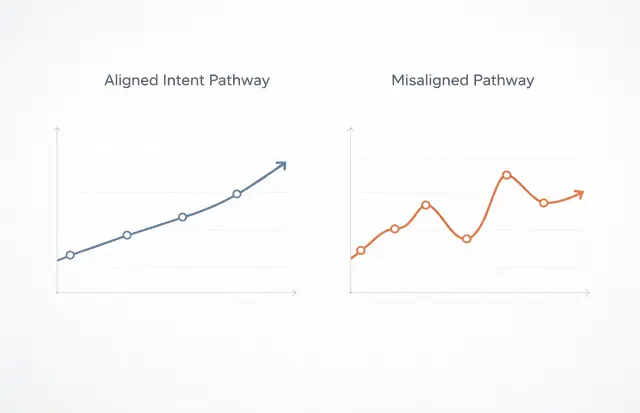
Search intent alignment has become central to authority evaluation. Modern systems assess not only whether content matches keywords, but whether it consistently satisfies the underlying informational, evaluative, or transactional intent associated with those queries.
Structural Consistency and Pattern Recognition
Modern authority evaluation relies heavily on pattern recognition across a domain. Search systems analyze structural consistency to determine whether content demonstrates stable editorial standards, coherent organization, and sustained topical focus.
Authority Across SEO, AEO, and Generative Systems
Authority is assessed across multiple retrieval and generation environments, not solely within traditional search rankings. SEO, answer engine optimization, and generative systems rely on shared signals applied through different extraction and synthesis mechanisms.
Generative systems depend heavily on pattern recognition and holistic domain assessment. Rather than ranking individual pages, they evaluate whether content ecosystems provide consistent, well-aligned coverage that can be safely summarized or referenced. This shift aligns directly with Generative Engine Optimization principles, where structural clarity and interpretive reliability determine whether content is selected for synthesis or exclusion.
Why Tactical SEO Fails in Modern Environments
Tactical SEO approaches fail because they attempt to influence authority without strengthening underlying structure. Short-term optimization can create temporary movement, but without cohesive architecture and aligned signals, those gains rarely translate into ranking durability.
When structural weakness compounds across a domain, it produces the same systemic fragility described in large scale AI content publishing risks. Pattern recognition across publishing behavior reveals whether improvements reflect genuine expertise or surface-level optimization.
The Emergence of Structural Authority
Structural authority has emerged as a defining framework in contemporary search evaluation. Systems assess how effectively a domain demonstrates expertise across interconnected topics instead of relying on singular performance metrics.

What Sustainable Authority Requires Now
Sustainable authority requires coordinated alignment across structure, intent, and editorial execution. Structural clarity and consistent expertise create durable authority that compounds rather than fluctuates.
How to Evaluate Your Own Authority Structure
Authority structure should be evaluated through observable patterns rather than isolated performance metrics. Domain-wide analysis begins by assessing whether content ecosystems demonstrate cohesive topical authority and consistent intent alignment.
Authority Is Architectural, Not Tactical

Modern authority evaluation reflects structural reality rather than tactical opportunity. Strength increases when structural authority aligns with topical authority and consistent intent alignment.
Across modern search and generative environments, authority persists when structure reinforces credibility at scale. Understanding how search engines evaluate authority clarifies why architectural integrity determines visibility through durable, interpretable expertise rather than reactive tactics.
Modern authority evaluation reflects a structural progression in search systems. Consistent intent alignment, aligned signals, and architectural clarity accumulate durable trust over time. Authority persists through sustained structural integrity across the entire content ecosystem.
Common Questions About Modern Search Authority
How has authority evaluation changed in modern search?
Authority evaluation has shifted from isolated page-level signals toward broader domain-level patterns. Modern search systems look at how consistently a site organizes topics, satisfies search intent, maintains editorial quality, and reinforces trust across its full content ecosystem.
Are backlinks and page optimization still enough to build authority?
Backlinks and page optimization can still support visibility, but they are not enough by themselves to create durable authority. A site also needs clear topical focus, consistent intent alignment, strong content structure, and reliable editorial patterns that search and generative systems can interpret across multiple pages.
How can site owners evaluate their authority structure?
Site owners can evaluate authority structure by reviewing whether related pages support one another, whether each article serves a clear purpose, and whether the domain shows consistent coverage around its core topics. Strong authority structure becomes easier to identify when content is organized, useful, aligned with reader intent, and consistent across the site.