SEO Content Workflow: How One SEOBoostAI Article Is Built

You may see a finished article and assume it was written in one pass, cleaned up quickly, and published.
That is not how SEOBoostAI works.
An SEO content workflow is the step-by-step process used to plan, create, optimize, review, and prepare an article for publication. Every article I create follows that structured workflow so keyword direction, search intent, article planning, section development, validation, internal linking, and image planning are handled deliberately, while carrying that same standard forward into every future article.
This matters because strong content is not the result of one good prompt or one lucky draft. It comes from a repeatable content creation workflow that gives each stage of the process a clear job. That is how an article becomes more than a page full of words. It becomes a structured content asset built for search visibility, reader clarity, and long-term consistency.
The workflow below gives you a clear view of the SEOBoostAI article creation process, from keyword discovery to final image generation.
Why a Structured SEO Content Workflow Matters
There is a major difference between content that is generated and content that is built.
Generated content may look fine at first glance, but that does not mean it is strategically sound, structurally strong, or publication-ready. It may miss the real search intent. It may cover the topic too broadly. It may repeat itself from section to section. It may sound clean on the surface while still carrying obvious AI residue underneath. It may even read well and still fail because the process behind it was never controlled.
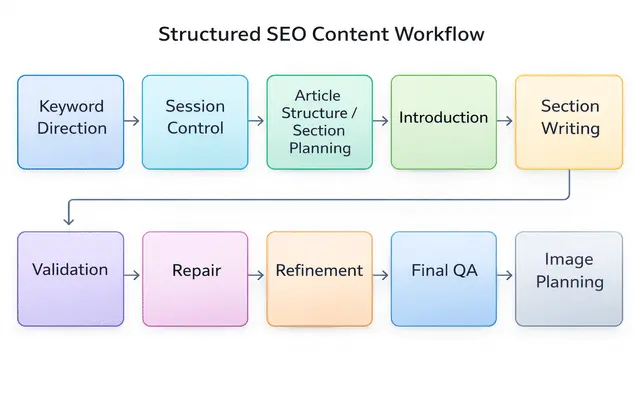
A structured content creation workflow solves that problem by breaking article production into stages. Each stage has a defined role. One stage identifies the keyword direction, another controls the writing session, another builds the structure, another develops the sections, another validates the article, another repairs weaknesses, and another handles AI content cleanup, voice alignment, authorial presence, and editorial QA. Then the image planning workflow applies the same structured thinking to the visual side of the page.
This is what makes the process repeatable. It does not depend on one strong draft. It depends on a system you can use again and again without lowering the standard.
The Strategic Foundation of the Article Production Workflow
Every article starts with strategy.
Before the first heading is created and before the first paragraph is written, the article needs a clear target. That is the job of the ARTICLE KEYWORD DISCOVERY PROMPT.
This stage identifies the primary keyword focus, supporting keyword directions, semantic language, and the real search intent the article needs to satisfy. It defines what the article is actually trying to do. That may sound obvious, but it is one of the most important parts of the entire SEO article writing process. A well-written article with a weak strategic foundation is still a weak article. If it targets the wrong phrase, misses the intent, or fails to cover the real topic depth the reader expects, the rest of the workflow is forced to build on unstable ground.
Keyword discovery gives the article its purpose. It helps define the topic boundaries, the audience, the likely informational burden of the page, and the language that needs to be present for the content to remain topically aligned. Without this stage, content creation becomes guesswork, which is why search intent has to be established before writing begins.
Once that strategic target is set, the session itself has to be controlled. That is the role of the CLIENT CONTENT SESSION INTRO PROMPT.
This part of the workflow establishes the operating environment for the article. It sets the rules, the boundaries, and the expected behavior for the rest of the writing process. In practical terms, this is what turns the article from a loose drafting exercise into a managed production environment. It is one of the key reasons this article production workflow can be reused across future pages without becoming inconsistent, following the same logic behind process-first prompt design.
This is also one of the clearest differences between casual content generation and a real SEO content workflow. In a casual process, the article starts when someone begins writing. In a controlled process, the article starts when the environment is defined.
Building the Article Before the Writing Begins
After the strategy is clear and the session is controlled, the article needs structure.
That is where the ARTICLE STRUCTURE GENERATION PROMPT comes in.
This stage creates the blueprint for the article. It determines how the topic should be broken down, what major sections are needed, how those sections should be ordered, and what each section is responsible for covering. This is not just a table of contents exercise. It is the architectural stage of the entire article creation process.

Structure determines depth, clarity, and whether the article develops naturally or falls into repetition.
If the section plan is too broad, the content tends to stay shallow. If it is too compressed, important ideas get forced together. If it is too repetitive, the article starts to feel mechanical long before the reader reaches the end.
Strong structure creates stronger downstream writing because each section begins with a real job to do. It is one of the reasons the article can later move through validation and quality control with much more precision. When the blueprint is solid, the article has a much better chance of becoming strong in finished form, which is exactly why repeatable AI prompt workflows perform better than one-pass drafting.
Once the structure is approved, the opening of the article is handled separately through the ARTICLE INTRODUCTION PROMPT.
The introduction has a different responsibility from the body sections, so it should not be treated like just another heading. It needs to frame the topic, establish relevance, create clarity for the reader, and set the article in motion. From the first paragraph, a strong introduction helps the article feel intentional and creates the bridge between the keyword target, the structural plan, and the reading experience.
This separation matters. In many articles, introductions are treated as filler. In a structured SEO workflow, the introduction has a real purpose. It starts the article properly.
How the Article Is Actually Written
Once the planning stages are complete, the body of the article is built through the SECTION EXECUTION, REVIEW, AND REVISION PROMPT.
This is the production engine of the workflow.

Instead of generating the article in one uncontrolled pass, the body is created section by section. Each section is written, reviewed, revised if necessary, and approved before the process moves forward. That one decision changes the quality of the entire workflow.
A managed section-based process gives tighter control over clarity, development, section differentiation, and consistency. This makes it easier to catch weak logic before it spreads across the rest of the article, helps preserve the purpose of each section, and makes it much harder for the article to collapse into a repetitive block of content where every heading sounds like a variation of the one before it.
This is one of the most important features of the SEOBoostAI content creation workflow because it removes luck from the equation. The article is not produced all at once and then inspected after the fact. It is built carefully as it goes. That level of control is one of the main reasons the same workflow can maintain quality across future articles instead of producing uneven results from one page to the next.
When every section has been created and approved, the article moves to the FINAL ARTICLE OUTPUT PROMPT.
This is the compilation stage.
Its purpose is not to revise the article, reinterpret it, or improve it. Its purpose is to output the full article exactly as approved, in the correct final format. That distinction is critical. At this stage, the article should already be complete. The final output step exists to preserve and present the approved work, not to reopen it.
This is where the article becomes a finished deliverable.
Validation, Structural Repair, and Content Quality Validation
A completed article is not automatically a finished article.
Once the full draft exists, the next question is whether the article actually became what it was supposed to become. That is the job of the ARTICLE QUALITY VALIDATION PROMPT.
This stage reviews the complete article as a whole. It looks at whether the structure truly worked, whether the sections carry distinct value, whether the development feels natural, and whether the page reflects the architecture that was intended earlier in the workflow. That is why content quality validation matters so much. A piece can look acceptable section by section and still feel repetitive, compressed, or underdeveloped when viewed as one article.
Validation answers the most important post-draft question: did the article execute properly?
If the answer is no, the next stage is not guesswork. It is ARTICLE STRUCTURAL REPAIR PROMPT.
This part of the article production workflow exists to correct structural weaknesses identified during validation. That may include weak section differentiation, development imbalance, compressed coverage, or places where the article does not fully support the original intent of the structure.
The reason this stage is separate is important. Diagnosis and correction should not be mixed together. One stage identifies the problem. Another stage fixes it. Keeping those jobs separate makes the workflow cleaner and more reliable. It also prevents the article from being casually rewritten without a defined reason.
This is how the workflow protects the article without forcing the entire process to start over, while still preserving the kind of quality signals discussed in modern AI content evaluation.
AI Content Cleanup, Voice, and Editorial QA
Once the article is structurally sound, it moves into refinement.
This is the stage where the page stops being merely complete and starts becoming publication-ready. The article now goes through AI content cleanup, voice alignment, authorial strengthening, final quality assurance, keyword execution review, and drift protection.
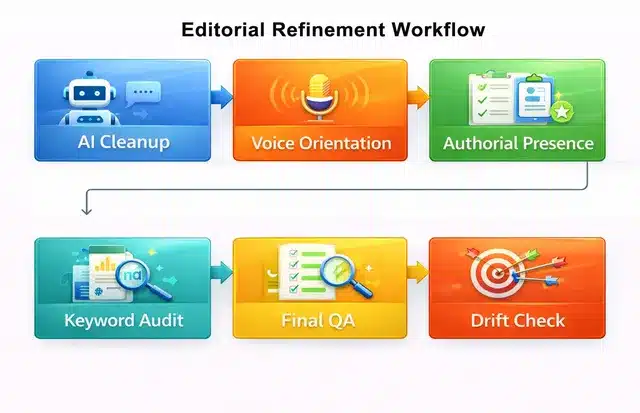
The first step here is AI TELL CLEANUP.
This pass removes the kinds of signals that make content feel obviously machine-generated. That can include unnatural phrasing, awkward transitions, repetitive patterns, over-structured sentence behavior, and other residue that often remains even when an article is technically sound. Readers do not always know why a page feels artificial, but they can usually sense it. Cleaning those signals out improves readability, credibility, and trust.
After that comes the VOICE ORIENTATION PASS.
Clean writing is not enough. It also needs to sound right. This stage aligns the article to the intended voice, tone, and communication style. It helps the piece feel more grounded, more natural, and more consistent with the standard the brand expects. This is not cosmetic editing. It is voice alignment.
Then comes the AUTHORIAL PRESENCE PASS.
Voice and authorial presence are not the same thing. A piece can sound clean and still feel generic. Authorial presence is what makes the article feel written by someone with judgment, confidence, and command of the topic. It adds authority without turning the article into opinion writing. That distinction is important because modern content is judged not only on accuracy, but on whether it feels deliberate, grounded, and trustworthy.
After those passes, the article moves into the FINAL QA PROMPTS.
This is the broad editorial QA workflow that checks the piece as a finished article. By this point the article has already gone through planning, drafting, validation, repair, AI cleanup, and voice refinement. Final QA exists to make sure those earlier steps actually produced a finished result and that no lingering issues remain before the article is considered complete.
Then the article is reviewed through the KEYWORD EXECUTION & INTENT COVERAGE AUDIT.
This stage asks a simple but essential question: does the article still do the job it was built to do?
That means verifying that the page still supports the primary keyword direction, still satisfies the original search intent, and still covers the topic with enough relevance and completeness. This matters because editorial improvement can sometimes weaken strategy if nobody checks it afterward. A polished article that loses its keyword purpose is still a problem. This stage protects the functional value of the page and reinforces the role of search intent in content evaluation.
Finally, the article goes through the FINAL LOCK & DRIFT CHECK.
Whenever content moves through multiple passes, there is always a risk of drift. Small changes can gradually alter emphasis, wording, structure, or direction. Even when each individual pass is helpful, the cumulative effect can pull the article away from the version that was originally approved.
This final stage confirms that the article remains the same article in substance, structure, and intent. It protects the integrity of the page before the visual planning workflow begins, which is part of preserving the same standard of quality and authority reflected in how search systems interpret authority signals.
How the Image Planning Workflow Supports the Article
At this point, the written article is complete.
The next stage is the visual side of the workflow, and this matters because strong imagery should support the article rather than feel random, disconnected, or inconsistent. That is why image planning is treated as its own structured process instead of an afterthought.
The first step is the CHARACTER ANCHOR LINE CREATION PROMPT.
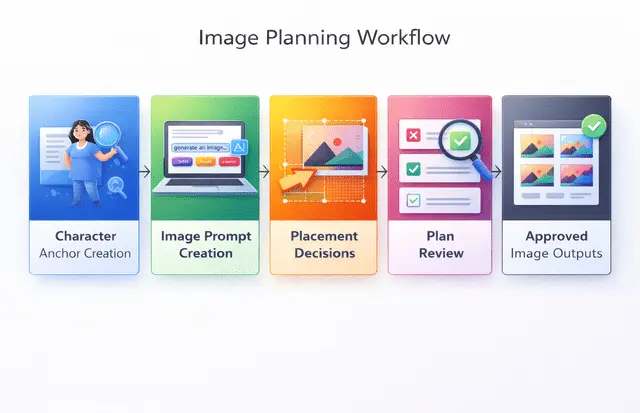
When article imagery includes people, consistency matters. This stage creates the stable visual anchor for recurring or section-based human imagery. It defines the professional role or business presence of the subject, the stated gender, the stated ethnicity, stable physical identifiers, and the overall demeanor that should remain consistent across relevant prompts.
Without that anchor, image systems can vary wildly from one prompt to the next. With it, the visual set feels intentional and connected. This is an important part of the image planning workflow because it keeps the article's human imagery from looking random.
Next comes the IMAGE PROMPT CREATION AND PLACEMENT PROMPT.
This is where the image system for the article is built. For each major section, image prompts are created to reflect the actual content of that section. These prompts are tied directly to the article architecture so that the visuals reinforce the page instead of simply decorating it. Placement is also determined here, which helps each image support the section it belongs to.
This matters because an image should have a job just like a paragraph does. It should support clarity, improve presentation, reinforce the content, and feel connected to the topic. Longer sections may also require supplemental image prompts, which is why the image planning process looks at the article as a whole rather than simply assigning one generic image per heading.
Before any image is generated, the workflow moves to the APPROVED IMAGE PLAN REVIEW PROMPT.
This is the quality control stage for the visual plan. It checks the prompt set for alignment, completeness, consistency, logic, and placement. It verifies that the image plan actually matches the article and that the prompts are strong enough to support reliable generation.
From Approved Visual Plan to Final Image Generation
Once the image plan is approved, the workflow moves into the final visual production stage.
Just like the article writing side begins with a controlled environment, the image side begins with IMAGE GENERATION SESSION INTRO PROMPT.
This stage establishes the execution environment for image generation. It sets the behavior and boundaries for the generation phase so the process stays tied to the approved visual plan rather than drifting into unnecessary improvisation. This is an important part of maintaining consistency. The visual workflow should be as disciplined as the writing workflow.
Then the process reaches IMAGE GENERATION ACTION PROMPT.
This is the final production step for the visual layer. At this point, the article is complete, the image plan has been reviewed and approved, and the system is ready to execute. This stage takes the approved prompts and carries out the actual image generation process.
That distinction matters. Planning and generation are not the same thing. One designs the image system. The other produces it. Keeping those jobs separate is one of the reasons the full workflow remains clean, controlled, and repeatable.
How SEOBoostAI Maintains Quality Across Every New Article
One finished article may look straightforward on the surface, but the process behind it is anything but casual.
Every stage in SEOBoostAI exists because it solves a different problem. Keyword direction is established first, then the writing environment, then the structure, then the introduction, then section development, then the final draft output, then article validation, and then structural repair. The refinement stack takes over from there through AI content cleanup, voice alignment, authorial presence, final QA, keyword execution review, and drift control. From there, the image planning and image generation workflows apply the same disciplined structure to the visual side of the page.

The result is not just one article.
The result is a repeatable SEO content workflow that can be used again and again without lowering standards, losing consistency, or relying on one-pass drafting. That is the real value of the system. It creates publication-ready SEO content through a process that can be maintained across future articles, not just one isolated page.
That is how one SEOBoostAI article is built.
More importantly, that is how the same standard is preserved, maintained, and recreated every time a new article enters the workflow.
Common Questions About the SEOBoostAI Article Workflow
What makes the SEOBoostAI workflow different from generating an article in one pass?
The SEOBoostAI workflow separates article creation into controlled stages instead of relying on one prompt to produce the entire page. Keyword direction, session setup, structure, section writing, validation, repair, editorial refinement, and image planning are handled one step at a time. This makes the process easier to review, easier to correct, and more consistent across future articles.
When is an SEOBoostAI article considered publication-ready?
An SEOBoostAI article is not considered publication-ready simply because the full draft has been written. It becomes publication-ready after the article has been validated, repaired if needed, cleaned for AI tells, aligned to the intended voice, reviewed for authorial presence, checked through final QA, confirmed against keyword and intent goals, and protected against drift.
Why is image planning included in the article workflow?
Image planning is included because article visuals should support the content instead of acting as decoration. SEOBoostAI connects images to the article structure, section purpose, placement needs, and visual consistency before generation begins. This helps the final page feel more complete, intentional, and aligned with the written article.