Authority Signals in AI-Driven Search Systems

Authority has traditionally been associated with signals like backlinks, domain strength, and overall visibility across the web. In AI-driven search, that picture becomes more complex. Systems that generate answers or retrieve supporting sources are not always looking for the same signals in the same way traditional search engines have relied on them. You need to understand authority through contextual fit, source consistency, entity relationships, retrieval behavior, and how clearly a source aligns with the topic being resolved. This changes how authority signals in AI search need to be understood, especially when you are creating content meant to be discovered, selected, and trusted in AI-mediated environments.
For beginners and intermediate readers, this shift matters because authority in AI search is not simply a modern version of link building. It reflects a broader evaluation pattern where relevance, clarity, credibility, and topical stability combine to shape how a source is treated. Understanding how AI determines authority helps explain why some sources are repeatedly surfaced while others are ignored, even when they appear strong by traditional standards. This article examines authority signals beyond backlinks and explains how AI search evaluates authority through contextual authority signals, retrieval decisions, and source-level trust.
How Authority Evaluation Changes in AI-Driven Search
Traditional search has often treated authority as a signal that can be inferred from established indicators such as backlinks, domain reputation, and the broader link environment surrounding a page or website. Those signals still matter in many search contexts, but AI-driven search changes the way authority is interpreted. Instead of relying as heavily on one dominant proxy, these systems often assess whether a source appears dependable within the specific context of the question, the topic being resolved, and the information being retrieved.
This creates a more interpretive model of authority. A source may look strong in conventional SEO terms and still fail to be surfaced prominently if its content does not match the informational need with enough clarity, consistency, or contextual precision. In the same way, a source with fewer traditional authority markers may still be selected when it demonstrates strong topical alignment, trustworthy framing, and a clearer fit for the retrieval task. For that reason, authority in AI search should be understood as a contextual judgment shaped by multiple interacting signals rather than a fixed status carried primarily by backlinks alone.
If you are trying to understand how AI search evaluates authority, the key shift is that authority is no longer just about being widely referenced. It is also about being interpretable, usable, and semantically aligned within a system that is trying to identify which sources best support a response. That broader evaluation model changes how authority needs to be understood across AI-driven search systems, especially when the goal is to be selected as a credible source rather than merely ranked as a visible page.
What Replaces Backlink-Heavy Authority Signals in AI Search
The central change is not that backlinks disappear, but that they stop functioning as the main shortcut for authority. In AI search, a source often has to do more than appear reputable from the outside. It has to be useful inside the actual retrieval and response process. That changes what counts as persuasive evidence of authority.
Signals that become more important in this environment include topical focus, consistent treatment of the subject, interpretable language, source credibility, and content that remains stable enough to support reliable retrieval. These are the kinds of qualities that help a system decide whether a page can be trusted as part of answer construction, not just whether it belongs to a well-known domain. This is part of how search engines evaluate authority beyond traditional signals when material is being selected for use rather than simply ranked by link-based strength.
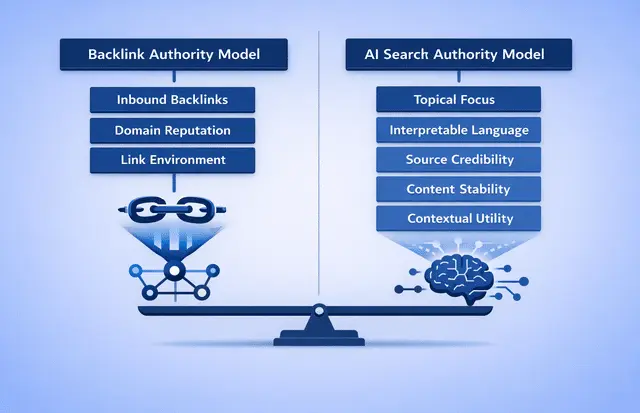
That difference matters because authority signals beyond backlinks are more closely tied to utility in context. A page may have strong traditional signals and still be a weak source if its purpose is unclear, its topic coverage is scattered, or its wording makes interpretation harder. A more focused source with stronger contextual authority signals may be easier for the system to retrieve, interpret, and rely on. In that sense, authority signals in AI search are increasingly supported by qualities that show the content is coherent, dependable, and usable within the specific topic environment.
So what replaces backlink-heavy logic is not one new metric, but a broader evaluation model. Backlinks may still contribute to AI search authority, but they sit inside a larger set of signals that help determine whether a source is credible, topically coherent, and fit for retrieval-based use. That is the key shift in why content optimization has changed from SEO to GEO across AI-driven search.
How Contextual Fit Influences Authority Interpretation
A source is not always treated as authoritative simply because it covers the right topic in a general sense. In AI-driven search, authority is often interpreted through how well the source fits the specific question, framing, and informational need at hand. This is where contextual fit in AI search becomes important. A page may be accurate and credible, but if its content does not align closely enough with the exact issue being resolved, it may be less useful to the system during retrieval or answer construction.
This makes contextual authority signals different from the broader authority signals in AI search and from broad subject relevance alone. AI systems often need content that matches the query context with enough precision to be usable without heavy reinterpretation. A source that explains a concept clearly within the right context may be selected over a more generally authoritative page that addresses the same topic in a looser or more indirect way. That difference becomes clearer when the system is choosing sources to support a specific response rather than deciding which pages deserve the highest general visibility.
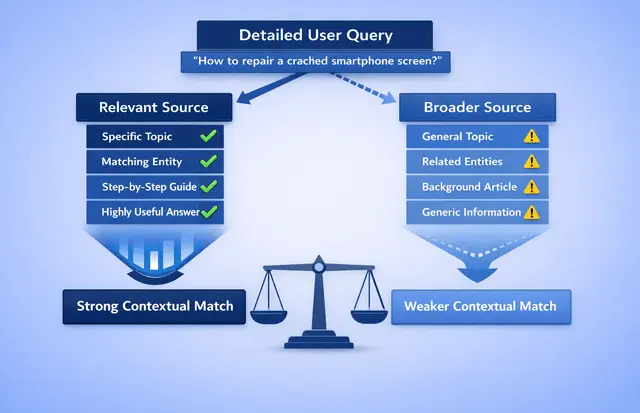
Contextual fit also helps explain why authority is not static across all query situations. The same source may be treated as highly useful in one context and less authoritative in another if the match is weaker. This does not mean the source has lost credibility. It means authority interpretation depends more on situational relevance, semantic alignment, and how directly the content resolves the active informational need. In that sense, contextual fit acts as a filter that helps determine when a source’s authority is most applicable within AI-driven search.
How Entity Relationships Help Establish Authority
Entity relationships help authority become legible to AI systems. Instead of reading a source only as an isolated page, AI-driven search often interprets whether that source sits in the right network of people, organizations, topics, products, studies, and other recognizable entities that define the subject area.
Authority becomes easier to establish when those relationships are coherent rather than incidental. A source covering a medical topic, for example, signals more authority when its content aligns naturally with recognized medical entities, accepted terminology, relevant source relationships, and authority signals in AI search. The same logic applies in other fields. When the surrounding entity pattern makes sense, the system has stronger evidence that the source belongs within the topic it is addressing.

Simply mentioning names or concepts is not enough. What matters is whether the entity relationships reinforce the source’s place in the topic environment in a way that feels semantically grounded and contextually credible. Clear entity structure helps strengthen AI search authority because it gives the system a stronger basis for understanding how the source connects to the knowledge framework around the subject.
In that role, entity relationships do not replace credibility, retrieval behavior, or topical consistency. They help establish authority by making the source easier to place, interpret, and trust within the larger subject map. That is the distinct contribution entity relationships make to authority evaluation in AI-driven search.
How Retrieval Behavior Affects Which Sources Are Used

Retrieval behavior decides whether authority gets applied at all. A source may be accurate, credible, and topically strong, but if the system does not surface it during retrieval, that authority never becomes operational inside the response process.
Why Some Sources Reach the Selection Stage
AI-driven systems are more likely to use sources that can be matched cleanly to the active informational need. This is where AI search retrieval signals matter. Clear wording, obvious topic resolution, and content that makes its relevance easy to detect all improve the chance that a page becomes a serious candidate during source selection.
What Weak Retrieval Looks Like in Practice
A page can contain sound information and still remain less usable if its structure blurs the main subject, its wording makes matching harder, or its relevance sits too far beneath setup and explanation. A more retrievable source may outperform a seemingly stronger one because it helps the system reach an answer with less ambiguity and less interpretive effort. In that kind of environment, authority signals in AI search become easier to apply when the source is not only credible, but also easy to retrieve and use.
Retrieval behavior operates differently from general trust. Source reliability in AI search still matters, but retrieval acts as the gate between possible authority and applied authority. It determines which sources are actually brought forward into use, which is why retrieval behavior affects which sources are used in a distinct and practical way.
Why Topical Consistency Matters in AI Search Authority
Not every signal of authority comes from what a single page says in isolation. In AI-driven search, authority often becomes more convincing when the surrounding content repeatedly supports the same subject area with stable focus and coherent coverage. That repeated coherence also strengthens authority signals in AI search.
Topical consistency matters because a source that stays grounded in its core domain, uses terminology in a consistent way, and develops related subject matter without drifting into loosely connected topics gives the system a clearer picture of what that source reliably represents within authority signals in AI search. This helps reduce uncertainty about whether the content reflects genuine subject depth or only temporary relevance around a narrow query.
Topical consistency also strengthens authority by making the source easier to interpret as a dependable participant in the broader topic environment. A page may answer one question well, but AI search authority becomes more durable when related pages reinforce the same area of expertise instead of pulling in unrelated directions. That repeated coherence supports the idea that the source is not simply matching a query once, but operating with sustained subject discipline. This closely connects to how AI-driven search changes long-term content strategy across an entire content environment.
In that sense, topical consistency helps distinguish durable authority from momentary visibility. It contributes to authority in AI search because the system can read the source as persistently anchored in the topic, not just briefly relevant to it. That broader pattern strengthens trust in how the source is interpreted across related retrieval situations.
How Source Credibility and Source Reliability Shape Trust
Source credibility and source reliability help shape trust in different ways. Credibility concerns whether the source appears believable on the topic in front of the system. Reliability concerns whether that source continues to behave in a dependable way when it appears again across related uses, which reinforces authority signals in AI search over time.
Those two layers should not be collapsed into the same thing. A source may create a strong first impression through accurate framing, clear topical grounding, and presentation that fits the expectations of the subject area. That supports source credibility in AI search. But trust deepens only when the same source also shows stable informational behavior over time, avoids erratic topic shifts, and remains dependable when retrieved repeatedly. That supports source reliability in AI search.
The distinction matters because weakness can appear on either side. Some sources sound convincing in a single passage but become less trustworthy when viewed across a broader content environment. Others remain consistently present on a topic yet weaken trust if their framing is imprecise or their claims do not feel well grounded. Trusted sources in AI search usually earn confidence on both levels rather than relying on only one. That distinction becomes easier to understand when you look at what content trust means in modern search beyond surface-level credibility.
When credibility and reliability align, the system has a stronger basis for trust. The source is easier to believe in the moment, and it is easier to reuse with confidence later. That combination also reinforces authority signals in AI search rather than functioning as a separate trust layer disconnected from authority evaluation.
What Content Needs to Demonstrate to Signal Authority in AI Search
To signal authority in AI search, your content needs to make three things easy to recognize: what it is about, how clearly it resolves the intended informational need, and why it is trustworthy enough to be used. That is the practical threshold. Authority is easier to detect when the content reduces ambiguity instead of adding interpretive work for the system.
In practice, that means the content should stay tightly aligned to its subject, use stable terminology, maintain coherent relationships between concepts, and frame the topic in a way that fits the expectations of the subject area. It should not drift across loosely related angles or try to force relevance through shallow keyword use. It also helps when the page behaves like part of a dependable content environment, where related pages reinforce the same area of expertise rather than pulling attention in competing directions.
Usability within retrieval conditions matters as much as surface relevance. A source may contain strong information and still send weak authority signals if its wording is vague, its structure is difficult to interpret, or its topic resolution is inconsistent. Content that demonstrates authority tends to make its central subject clear, its informational role stable, and its value easy to apply in context. That principle overlaps with how search engines interpret user intent from content signals when they decide whether a page truly matches the need behind a query.
Signaling authority in AI search depends on producing content that is coherent, topically grounded, interpretable, and dependable enough to be selected, trusted, and used. When those qualities are consistently present, authority signals in AI search become much easier for AI-driven search systems to recognize.
Authority in AI-driven search is shaped by how clearly a source proves it can be understood, trusted, and used in context. When your content consistently demonstrates those qualities, it becomes easier for both search systems and readers to treat that source as a dependable authority within the broader pattern of authority signals in AI search.
Common Questions About Authority Signals in AI-Driven Search
Do backlinks still matter for authority in AI-driven search?
Backlinks can still contribute to authority, but they are no longer the only signal that matters. AI-driven search also looks at whether a source is clear, topically consistent, contextually useful, and reliable enough to support a specific answer or retrieval task.
Why can a smaller or less visible source be selected over a stronger traditional website?
A smaller source may be selected when it answers the specific question more clearly, fits the context more closely, and gives the system less ambiguity to resolve. In AI-driven search, practical usefulness inside the retrieval process can sometimes outweigh broader visibility or traditional domain strength.
What is the most practical way to strengthen authority signals in AI search?
The most practical way to strengthen authority signals is to make the content easier to interpret, retrieve, and trust. That means using stable terminology, staying focused on the subject, explaining concepts clearly, supporting related topics consistently, and avoiding vague or scattered coverage.