Content Built to Rank vs. Content Built to Be Cited
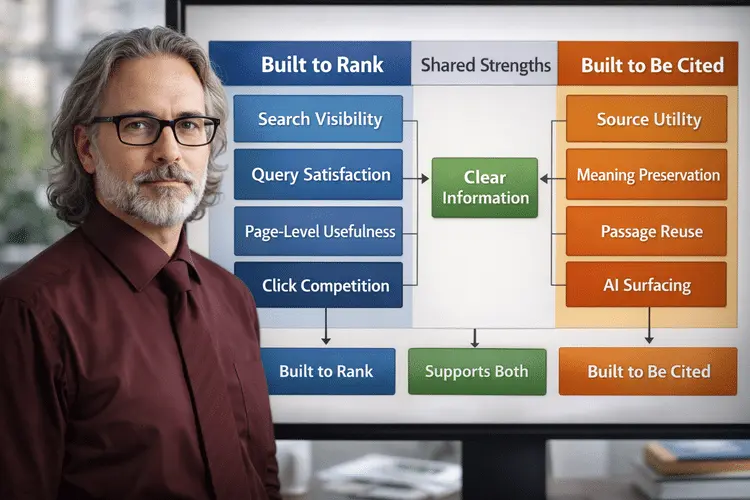
How search-driven content differs from content built to function as a reusable reference source
The difference in ranking content vs citation content is not just a matter of visibility. It is a difference in design purpose. Some pages are created primarily to compete for search attention, satisfy query intent, and earn clicks. Other pages are structured to function as citation-worthy content that can be extracted, summarized, reused, or surfaced as a reliable source in AI-mediated environments. Those goals can overlap, but they are not the same, and the content design differences matter.
That distinction becomes more important as content is judged not only by where it ranks, but by how well it holds meaning outside its original page context. Content built to rank may succeed at attracting visits, while content built to be cited must also support extractable content, summarizable content, and clear reuse in AI systems. In practice, source usefulness depends on more than search visibility alone. It depends on how clearly ideas are defined, how well sections preserve meaning when separated from the page, and how dependable the content remains when surfaced as AI reference content.
This comparison does not argue that one model is better than the other. It clarifies how content roles change when a page is expected to rank, inform, and also function as reusable content in environments shaped by extraction, summarization, and AI surfacing.
What Ranking Content and Citation-Oriented Content Are
Content Built to Rank
Pages built to rank are created primarily to perform well in search environments. Their job is to align with search intent, compete for visibility, and help a page earn clicks for relevant queries. In most cases, that means the content is structured to match what users are looking for, cover the topic clearly enough to satisfy the query, and support overall SEO performance. Strong ranking content can be useful, accurate, and well organized, but its first design priority is usually discoverability.
Ranking-focused pages should not be treated as shallow or low quality. Many are highly informative. Their success is often measured first by how well they attract attention in search results and how effectively they meet page-level visibility goals. Content built to rank is therefore best understood as search-facing content, a distinction that helps frame ranking content vs citation content as a difference in role rather than a difference in quality.
Content Built to Be Cited
Content built to be cited serves a different primary role. It is designed to function as citation-worthy content that can be summarized, reused, extracted, or surfaced as a reliable source without losing its intended meaning. This kind of AI reference content must do more than answer a query well on the page where it appears. It must also remain clear when a passage is separated from the full article and reused in a different context.
That requirement changes what matters in the writing. Citation-ready content and reference-grade content depend more heavily on definitional clarity, concept separation, direct phrasing, and structure that preserves meaning under partial reuse. A page can be visible without being especially reusable, but content built to be cited is designed with source utility in mind. It is written so that a section, paragraph, or explanation can still function as dependable reference material when it is quoted, summarized, or surfaced in AI-mediated environments.
The Difference Is in the Content Role
Ranking content vs citation content becomes easier to understand when the role each type is meant to play is examined directly. Content built to rank is optimized first for search visibility and query satisfaction. Content built to be cited is optimized first for source usefulness, meaning preservation, and reusable content design. Those roles can overlap, and strong pages may support both, but they are not identical. The distinction matters because content reuse in AI systems places value on extractable content and summarizable content in ways that traditional visibility alone does not fully measure.
The Different Jobs These Two Content Types Are Designed to Do
The most important distinction between content built to rank and content built to be cited is the job each one is expected to perform. Content built to rank is created to win visibility for relevant searches, align with user intent, and help a page compete effectively in search results. By contrast, content built to be cited is created to function as reliable reference material that can be surfaced, reused, summarized, or quoted without losing clarity. Both may inform the reader, but they are designed to succeed in different ways.
The job of content built to rank is largely search-facing. It must attract attention, match the likely intent behind a query, and give search engines enough topical relevance and content clarity to justify visibility. That makes ranking-focused pages highly concerned with discoverability, query satisfaction, and page-level usefulness. A strong search-facing page may answer the right question at the right time and still do its job well even if only a small portion of it is ever reused elsewhere.
The job of content built to be cited is more source-facing. It must provide usable explanations that hold together when a section, paragraph, or sentence is extracted from the original page context. That changes the standard of success. Citation-worthy content is expected to support source usefulness, content reuse in AI systems, and dependable meaning preservation under summarization. In that environment, reference-grade content is judged not only by whether it answers a question, but by whether it does so in a form that remains stable when passed through another system, another interface, or another layer of interpretation.
Ranking content vs citation content should not be treated as a simple quality comparison. The central question is whether the content was designed for the role it needs to serve. Content built to rank may perform well when visibility is the main objective. Content built to be cited may perform better when extractable content, reusable content, and citation-ready content are required. Some pages can support both jobs, but the difference in design purpose has to be recognized before structure, wording, and evaluation can be handled correctly.
Where Ranking Content and Citation-Oriented Content Overlap
They Both Depend on Clear, Useful Information
Content built to rank and content built to be cited are not opposites. Both depend on content that is relevant, understandable, and genuinely useful to the reader. In both cases, weak explanations, vague language, and poor topical alignment reduce performance. A page that lacks clarity will struggle to satisfy search intent, and it will also struggle to function as dependable reference material when surfaced or reused elsewhere.
That shared foundation matters because citation-worthy content does not begin where SEO ends. Strong search-facing writing often already includes qualities that improve citation-oriented usefulness, such as direct language, clean topic focus, and logically organized sections. In the same way, reference-grade content often benefits from the same clarity and relevance that help a page perform well in search. The overlap exists because both content roles depend on understandable, trustworthy communication.
Some Structural Strengths Support Both Roles
Certain content design choices show why ranking content vs citation content can share structural strengths. Clear definitions, accurate terminology, well-scoped sections, and direct answers can help a page match informational intent while also making it easier for passages to be extracted and summarized without distortion. When content is organized around meaningful subtopics instead of loose narrative flow, it becomes more usable for search visitors and more stable for content reuse in AI systems.
Overlap Does Not Eliminate the Distinction
The presence of overlap does not mean content built to rank and content built to be cited are doing the same job. A page can share important strengths across both models while still being designed primarily for one role over the other. Content built to rank may benefit from clarity that also improves source utility, yet still be structured mainly for visibility and query satisfaction. Content built to be cited may also perform well in search, yet still be designed first for extractable content, summarizable content, and dependable reuse.
The practical point is that overlap should be understood as shared support, not shared purpose. Good content can serve both search visibility and AI surfacing, but the fact that the same page may support both does not erase the difference between content built to rank vs content built to be cited. The two models intersect through clarity, structure, and usefulness, while remaining distinct in the role they are meant to fulfill.
How Content Structure Affects Extraction, Summarization, and Reuse
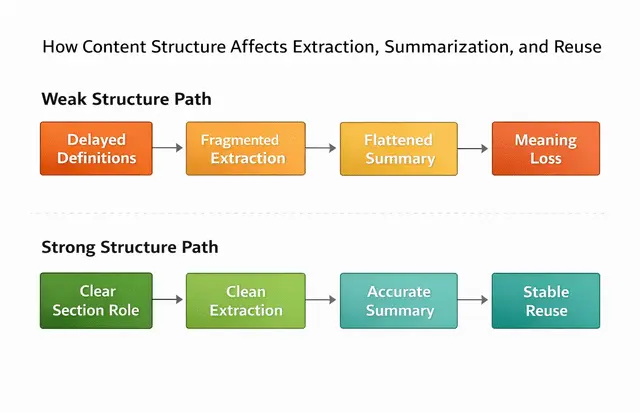
Content structure plays a direct role in whether an explanation can survive outside the page where it was originally published. When material is extracted, summarized, or reused, it is often separated from the surrounding introduction, supporting paragraphs, and internal context that helped the original reader interpret it. A section that depends too heavily on buildup, vague references, or implied meaning may still work on the page itself, yet lose clarity once only part of it is surfaced elsewhere. That is why extractable content is not defined by topic alone. It is shaped by how clearly the content is organized and how well each passage carries its own meaning.
Summarizable content depends on the same principle. If the structure of a section makes the core point easy to identify, another system can usually preserve that point more accurately when compressing the material. If the structure is loose, indirect, or overly dependent on narrative flow, summarization is more likely to flatten distinctions or blur what the content was actually saying. In practice, content reuse in AI systems favors writing that resolves the main idea cleanly, keeps related concepts properly separated, and reduces the amount of interpretation needed to reconstruct the intended meaning.
What Weak Structure Looks Like Under Reuse
Weak structure does not always look weak when read in full. A page may feel smooth, readable, and complete while still being difficult to reuse well. This usually happens when important definitions are delayed, key distinctions are spread across multiple paragraphs without clear boundaries, or meaning depends on surrounding transitions rather than direct explanation. Under those conditions, reusable content becomes harder to preserve because extracted passages do not carry enough independent clarity. The result is lower source usefulness, even when the original page appears informative to a human reader moving through it in sequence.
What Strong Structure Supports
Structure that supports citation-ready content does the opposite. It gives each section a clear informational role, makes the main point identifiable early enough to survive partial reuse, and keeps concept boundaries stable when the material is shortened or quoted. Reference-grade structure does not require robotic writing, but it does require deliberate control over how meaning is distributed. Definitions need to be anchored clearly, comparisons need to stay precise, and explanatory units need to hold together when separated from the larger page.
This is why content design differences matter so much in ranking content vs citation content. A page built mainly for visibility can succeed with structure that supports the reader during full-page consumption. A page built to be cited needs stronger passage-level control because reuse, AI surfacing, and summarization place more pressure on local clarity. The issue is not whether one structure is universally better, but whether the structure matches the downstream use the content is expected to support.
What Makes Content More Dependable as a Reusable Source in AI-Mediated Environments
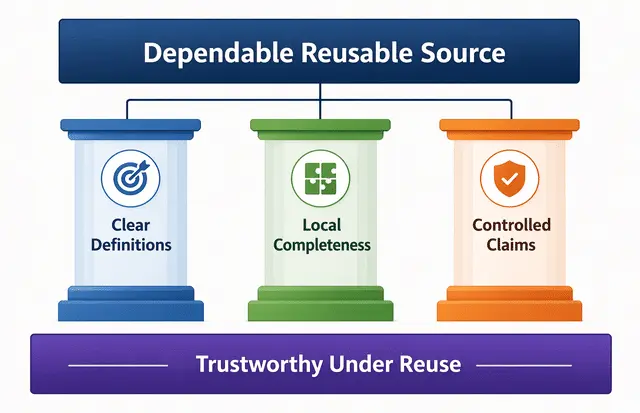
Content becomes more dependable as a reusable source when its meaning remains stable under reuse. In AI-mediated environments, that stability matters because passages are often surfaced without the full page, shortened without the original pacing, or integrated into answers that combine material from multiple sources. A dependable source is not just informative in its original setting. It is also clear enough, bounded enough, and structurally controlled enough to remain trustworthy when only part of the content is encountered.
Clear Definitions and Stable Concept Boundaries
One of the strongest signals of source usefulness is definitional control. When terms are defined clearly and related ideas are kept distinct, the content is less likely to be misread when extracted or summarized. This is especially important in reference-grade content, where small shifts in wording can change the meaning of a distinction or weaken the accuracy of a comparison. Reusable content works better when the reader, or another system, does not have to infer what a term was supposed to mean from surrounding context alone.
Explanations That Hold Together Outside the Page
Dependable source material also needs local completeness. That does not mean every paragraph must restate the entire article. It means a section or passage should carry enough of its own logic that the main claim, explanation, or distinction still makes sense when separated from nearby material. Citation-worthy content is more reliable when it avoids vague references, unclear pronouns, and explanations that only become understandable after reading multiple surrounding sections. The more a passage depends on hidden context, the less stable it becomes under reuse.
Controlled Claims and Interpretable Structure
Content is also more dependable when its claims are proportionate to what the section actually establishes. Overextended wording, blurred comparisons, and loosely framed conclusions make reused passages easier to distort. By contrast, AI reference content becomes more reliable when each section stays within a clear informational role and presents its point in a way that can be interpreted without reconstruction. In practical terms, source dependability comes from a combination of precision, structural discipline, and meaning preservation. Those qualities make content more useful not only for human readers, but also for systems that surface, summarize, and reuse source material outside its original page context.
Why Search Visibility and Source Utility Are Not the Same Thing
In ranking content vs citation content, search visibility and source utility answer different questions about content performance. Search visibility asks whether a page is likely to be found for relevant queries. Source utility asks whether the content on that page remains useful when a passage is extracted, summarized, quoted, or reused as reference material. Those are related outcomes, but they are measured at different levels and should not be treated as the same signal.
Search visibility is mostly a page-level outcome. It reflects how well the page aligns to demand, intent, and competitive search conditions. Source utility is mostly a passage-level outcome. It reflects whether a section or explanation holds its meaning when the reader no longer has the full page, original transitions, or broader article structure in front of them. A page can therefore earn visibility while still containing passages that are too context-dependent, too loosely framed, or too interpretive to function well under reuse.
The reverse can also happen. A page may contain reference-grade explanations with strong definitional clarity and stable meaning, yet still have limited search visibility because discoverability depends on more than passage quality alone. That is why ranking content vs citation content should be evaluated through separate but connected lenses. Visibility shows whether content can be found. Source utility shows whether the content remains dependable after discovery, when reuse pressure shifts attention from the page as a whole to the quality of its individual explanatory units.
How to Assess Whether Content Is Built to Rank, Be Cited, or Support Both
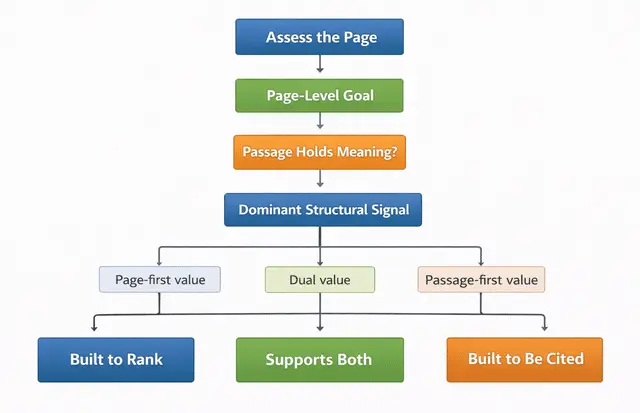
Assessing ranking content vs citation content starts with the kind of performance the page appears designed to deliver. The question is not whether the content is generally strong. The question is what kind of usefulness the structure, phrasing, and section design are trying to make possible. A useful assessment therefore looks for design signals, not just overall quality.
Start With the Page-Level Goal
If the page is mainly optimized to win search attention, align to query intent, and perform as a complete on-page answer, it is more likely to be built primarily to rank. If the page is structured so that individual sections can function as dependable source material outside the full article, it is more likely to be built primarily to be cited. When both goals are visible from the start, the page may be designed to support both discovery and reuse.
Test the Passage, Not Just the Page
A practical way to assess source utility is to remove local context and see what remains. If a paragraph or section still defines its subject clearly, preserves its main distinction, and makes sense without surrounding setup, the content is showing citation-ready behavior. If the meaning weakens quickly once transitions, prior paragraphs, or article-level framing disappear, the content is leaning more heavily toward page-bound usefulness.
Look for the Dominant Structural Signal
The strongest signal is usually the unit that carries most of the content's value. When the value depends mainly on the page being read in full, the content is usually built to rank first. When substantial value survives at the section or passage level, the content is more likely to support reference-grade use. Content that supports both roles usually shows both page-level relevance and passage-level stability, rather than relying entirely on one or the other.
Classify the Page by Its Primary Burden
After those checks, ranking content vs citation content becomes easier to classify. Content built to rank is designed first for discoverability and full-page usefulness. By contrast, content built to be cited is designed first for extractable content, summarizable content, and dependable reuse. Pages that support both combine search-facing relevance with reusable content design. The point of the assessment is not to force a label for its own sake. It is to identify which role the page is actually built to fulfill, so its performance can be judged against the right standard.
When Ranking Content and Citation-Oriented Content Should Work Together
Ranking content and citation-oriented content should work together when a page needs to do more than earn visibility. If the page is expected not only to be found, but also to function as dependable source material after discovery, then search-facing performance and source utility have to be developed together. This matters most for pages built to answer recurring questions, clarify important distinctions, or provide explanations likely to be extracted, summarized, or reused in AI-mediated environments.
When Discovery Alone Is Not Enough
In that situation, visibility is only the first requirement. The page still needs to satisfy search intent, remain topically relevant, and compete effectively for attention, but it also needs structure that helps meaning survive beyond the original page experience. That means the content cannot rely only on page-level usefulness. It also needs section-level and passage-level clarity strong enough to support extractable content, summarizable content, and reliable reuse without heavy dependence on surrounding context.
When both roles matter, the goal is not to force citation-ready content on every page. The goal is to recognize when discovery and reuse are both realistic expectations for the same asset. Once that is true, content built to rank and content built to be cited stop functioning as separate choices and start functioning as coordinated design priorities.
How the Balance Should Be Decided
The balance in ranking content vs citation content should follow the page's intended job. Some pages are primarily built for search visibility, and that is appropriate when discoverability and on-page usefulness are the main goals. Other pages should carry stronger source utility because they are more likely to be referenced, quoted, or surfaced as AI reference content. The strongest overlap happens when a page is built with enough clarity to rank, enough structural discipline to preserve meaning under reuse, and enough precision to remain useful after extraction.
Use search visibility to help content enter the conversation, and use source utility to help it remain useful once it is there. The most effective pages are usually the ones designed with a clear understanding of which role matters most, and when both roles need to work in parallel.
Content built to rank and content built to be cited serve different roles, but they often create the most value when those roles are aligned instead of confused. The clearest content strategy for ranking content vs citation content is not to treat visibility and reuse as the same objective, but to build the page for the kind of usefulness it is actually expected to deliver.
Common Questions About Content Built to Rank vs. Content Built to Be Cited
Can the same article be built to rank and be cited?
Yes. The same article can support both goals when it is designed for search visibility and passage-level usefulness. To do that well, the page needs clear topical relevance, strong structure, direct explanations, and sections that still make sense when they are summarized or separated from the full article.
Why is ranking well not enough for content reuse in AI systems?
Ranking well helps a page become discoverable, but it does not automatically make the content dependable as a reusable source. AI-mediated reuse places more pressure on individual passages, definitions, and explanations because those pieces may be extracted or summarized without the full page context.
Should every page be built to function as citation-ready content?
No. Not every page needs to function as citation-ready content. Some pages are mainly designed for discovery, navigation, conversion, or basic query satisfaction. Citation-ready structure matters most when a page is expected to explain important concepts, clarify distinctions, answer recurring questions, or serve as dependable reference material after discovery.
What role does structure play in whether content can be reused or summarized?
Structure determines how easily the main idea of a passage can survive outside the full article. Clear definitions, focused sections, and stable concept boundaries make content easier to extract, summarize, and reuse without distorting its meaning. Weak structure can make even useful content harder to interpret when only part of the page is surfaced.
How can you tell if content is citation-ready?
Content is more citation-ready when its sections provide clear definitions, stable distinctions, and explanations that hold their meaning outside the original page. A practical test is to read a single section or paragraph by itself and check whether the main idea remains clear without relying on surrounding setup.