How AI Systems Interpret Content Structure Beyond Keywords

To understand how AI interprets content structure, start with a simple distinction: keywords help signal topic relevance, but they do not fully explain how meaning is organized, separated, and understood within a page. In AI-facing environments, structure also matters. Heading hierarchy, segmentation, content organization, and information design help show which ideas belong together, which points are subordinate, where one concept ends and another begins, and how the overall topic should be interpreted beyond isolated terms. That is part of why content structure for AI systems cannot be reduced to keyword placement alone.
When content is clearly organized, AI systems have a stronger basis for identifying context, resolving relationships between related ideas, and retrieving passages that preserve meaning outside the full page. That does not make keywords obsolete, and it does not mean structure alone controls interpretation. It means that AI content structure beyond keywords plays a real role in how information is parsed, framed, and reused. When you work with semantic content structure, heading hierarchy, segmentation, and structural clarity, the practical question is not whether keywords matter, but how content structure for AI helps those keywords operate inside a page that is easier to interpret correctly.
Why Keywords Alone Cannot Fully Explain AI Interpretation
Keywords still matter because they help identify topic relevance, recurring subject matter, and the language a page uses to describe its focus. That remains true in both search-facing and AI-facing environments. But keywords do not fully explain how meaning is organized inside a piece of content, how ideas relate to one another, or which parts of a page carry the most interpretive weight. That is the limitation in treating keyword placement as a complete model of how AI interprets content structure.
A page can contain the right terms and still remain structurally unclear. Two articles may use many of the same keywords, yet produce very different interpretive signals depending on how the information is arranged. When a page separates concepts cleanly, defines scope through headings, and places related ideas in stable sections, it gives clearer guidance about what each passage is doing. When the same terms are scattered across weakly organized content, the keyword signal may still exist, but the surrounding context becomes less reliable. That is one reason AI content structure beyond keywords matters in practice.
This difference becomes easier to see when similar terms serve different roles within the same article. A keyword may appear in a definition, a comparison, an example, or a qualification, but the term itself does not tell an AI system which role it is playing. Content structure for AI systems helps clarify whether a passage is introducing a concept, narrowing it, contrasting it with a related idea, or extending it into a practical implication. In that sense, content structure for AI is not competing with keywords. It helps organize the meaning around them.
The practical point is not that keywords are outdated or unimportant. It is that keyword presence alone cannot account for hierarchy, segmentation, emphasis, and conceptual boundaries. AI content hierarchy and content organization help shape interpretation in ways that simple term placement cannot fully control. To understand how AI interprets content structure, look beyond whether a keyword appears and examine how the page frames, separates, and prioritizes the information built around it.
What Content Structure Signals in AI-Facing Environments
Content structure signals are the organizational cues that help show how information is grouped, prioritized, separated, and related within a page. They do not replace topic terms or relevance language, but they add another layer of meaning that keywords alone cannot supply. In AI-facing environments, these signals help indicate whether a passage is introducing a main idea, narrowing a concept, qualifying a claim, or connecting one idea to another within a larger semantic content structure.
Some of those signals define context and boundaries. Heading hierarchy, section breaks, and segmentation can show which material belongs to a primary topic and which material functions as supporting detail. This matters because AI content parsing is influenced not only by the presence of terms, but by the boundaries that separate one unit of meaning from another. When those boundaries are clear, a passage is easier to interpret as a stable source unit rather than as a fragment whose role depends heavily on nearby text.
Other signals help clarify relationships and priority. Content organization, information architecture, and content layout signals can indicate which ideas anchor the page, which points support those ideas, and which passages carry narrower explanatory roles. That makes it easier to distinguish whether related concepts are being treated as equivalents, contrasts, extensions, or separate subtopics, and it also helps show what appears central, subordinate, adjacent, or interpretively linked.
That broader signal layer is why AI content structure beyond keywords deserves separate attention. Keywords still help identify topical relevance, but structured content for AI search also depends on hierarchical markup, stable passage design, and clear internal relationships between concepts. The point is not that every structural element carries equal weight. It is that content structure for AI includes multiple forms of organizational signaling that shape interpretation before any single heading, section boundary, or retrieval behavior is examined on its own.
How Heading Hierarchy Defines Context, Scope, and Topical Priority
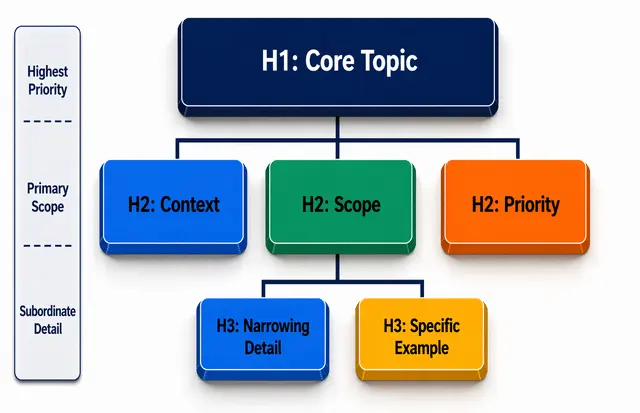
Heading hierarchy does more than organize a page visually. It helps define how information is scoped, how sections relate to one another, and which ideas appear to carry the highest topical weight. In AI-facing environments, heading hierarchy can serve as a structural guide that helps interpret whether a passage belongs to a broad subject, a narrower subtopic, or a supporting clarification within a larger content structure for AI systems.
Headings do not merely label blocks of text. They create boundaries around meaning. A strong heading hierarchy can show that one section introduces a primary concept, while later sections refine, contrast, or extend that concept without replacing it. When hierarchical markup reflects the real structure of the page, AI interpretation becomes less dependent on scattered keyword repetition and more grounded in a clear semantic organization of ideas. That makes it easier to determine what a section is about, how wide its scope is, and how it should be understood in relation to the rest of the page.
Hierarchy also helps signal topical priority. Content placed under a higher-level heading usually carries a different role from content placed under a subordinate heading, even when both discuss related terms. That distinction helps explain why two passages using similar language may not communicate the same level of importance. One may define the central topic, while the other may qualify it, narrow it, or provide a specific example. AI content hierarchy helps make those differences more visible by showing which ideas anchor the page and which ideas operate underneath them.
When heading hierarchy is weak, inconsistent, or misaligned with the actual content, interpretive problems become more likely. A page may still contain relevant keywords, but the structural signal around those terms becomes less stable. That weakens structural clarity and makes it harder to preserve meaning under extraction, summarization, or passage reuse. To understand how AI interprets content structure, do not stop at whether headings exist. The more important question is whether the hierarchy accurately defines context, limits scope, and signals which topics deserve primary attention.
How Segmentation Separates Ideas and Stabilizes Passage Meaning
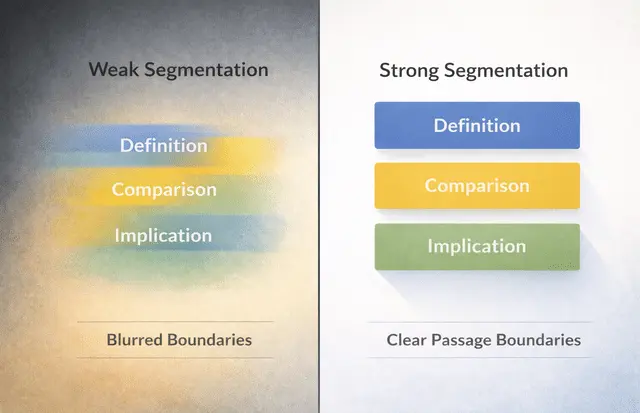
Segmentation is the practice of dividing content into clear units so each part carries a more stable role, scope, and meaning. In AI-facing environments, segmentation helps show where one idea ends, where another begins, and how much conceptual material belongs inside a single passage. AI interpretation becomes less reliable when multiple ideas are blended together without clean boundaries, even when the page uses relevant keywords throughout.
How Segmentation Separates Ideas
When content is segmented well, each section or paragraph has a clearer job. One passage can define a concept, another can distinguish it from a related idea, and another can explain a practical implication without collapsing those functions into one block. That makes AI content parsing easier because the structure provides more stable passage boundaries. Instead of treating the page as a loose stream of related language, the system can interpret smaller units with clearer internal purpose.
That separation is especially important when a topic includes closely related concepts. Without segmentation, semantic content structure can become blurred, and similar terms may start competing for the same interpretive space. A reader may still follow the material, but an extracted passage may lose precision because the surrounding signals are doing too much of the clarifying work. Segmentation helps prevent that problem by giving each idea enough room to stand on its own without depending entirely on adjacent text for its basic meaning.
How Segmentation Stabilizes Passage Meaning
Segmentation also helps stabilize meaning under retrieval, summarization, and reuse. A clearly bounded passage is more likely to preserve its intended role when it is surfaced outside the full article. If the content organization keeps definitions, distinctions, and qualifications in the right structural place, the passage is easier to reuse as a source unit without distorting what it was meant to say. That is one reason content structure for AI systems depends on more than the presence of relevant terms.
Not every short paragraph becomes useful simply because it is isolated. Segmentation works when the boundaries reflect real conceptual divisions rather than arbitrary visual breaks. Strong segmentation improves structural clarity by aligning passage boundaries with meaning boundaries. In practice, that helps explain why AI content structure beyond keywords includes more than topic wording alone. It also includes how content is divided into interpretable units that preserve meaning more reliably when read, retrieved, or summarized out of sequence.
How Content Organization Shapes Interpretive Order and Context Flow
Content organization affects how AI interprets content structure by controlling the order in which information becomes available. For AI-facing systems, that sequence helps shape how a topic is framed before later passages add detail, contrast, or qualification. When a page introduces concepts in a coherent order, each section builds on a more stable base. When the order is weak or erratic, later passages may still contain useful information, but the surrounding context becomes harder to resolve with confidence.
Interpretive order matters separately from segmentation alone. Segmentation helps define where one idea stops and another starts. Content organization determines which ideas arrive first, which ones anchor the page, and which points are asked to carry meaning after that foundation is already in place. A page may have clean passage boundaries and still create confusion if it presents supporting details before defining the main concept, or if it introduces distinctions before establishing what is being distinguished. In that sense, AI content organization influences not just what information exists on the page, but how that information is prepared for understanding.
Context flow also shapes how relationships are interpreted across sections. When related ideas appear in a deliberate progression, semantic organization becomes easier to follow because each passage inherits a clearer role from what came before it. One section may establish the core concept, another may narrow the scope, and a later section may explain the implication of that narrowed definition. If that order is reversed or fragmented, the same terms may still appear, but the reader and the system both receive weaker guidance about how the parts connect. This is one reason content structure for AI depends on more than isolated signals inside individual passages.
Strong content organization does not mean every article must follow the same formula. It means the arrangement of sections should match the logic of the subject so the page creates a usable interpretive path. That path helps preserve meaning during retrieval, supports clearer summarization, and reduces the chance that a passage will be read outside the role the page originally gave it. For content structure for AI systems, the question is not only whether the page contains the right information, but whether the information appears in an order that makes the intended meaning easier to carry forward.
How Information Design Clarifies Relationships Between Related Concepts
Information design affects interpretation by showing how related ideas should be read in relation to one another. For AI-facing systems, many topics are not made up of isolated facts. They involve definitions, contrasts, dependencies, examples, qualifications, and layered explanations that must be arranged in a way that preserves conceptual separation. Information design helps make those relationships visible so that similar ideas are not treated as interchangeable simply because they appear on the same page.
Related concepts often share vocabulary while serving different functions. One term may identify the main subject, another may narrow it, and another may describe a condition that changes how the first two should be understood. Information design helps clarify those differences by controlling how material is framed, grouped, and positioned. When that structure is clear, AI interpretation is less likely to flatten related ideas into one blended meaning.
This becomes especially important when a page explains concepts that are adjacent but not equivalent. A comparison, a refinement, and a supporting example may all use overlapping language, yet each one carries a different interpretive role. Structural clarity helps show whether the page is defining a concept, distinguishing it from a neighboring concept, or showing how the concept behaves in practice. That distinction supports stronger semantic organization because the page is not relying on shared keywords alone to communicate the relationship.
Good information design also helps preserve meaning and shows how AI interprets content structure when passages are retrieved or summarized outside the original article flow. A clearly designed section makes it easier to see what idea a passage belongs to and what relationship it is meant to express. That improves extractability because the passage is more likely to retain the right conceptual boundary when read on its own. For content structure for AI systems, information design is not decoration layered on top of content. It is part of how the page communicates conceptual relationships in the first place.
How Structural Signals Influence Retrieval Without Replacing Keywords
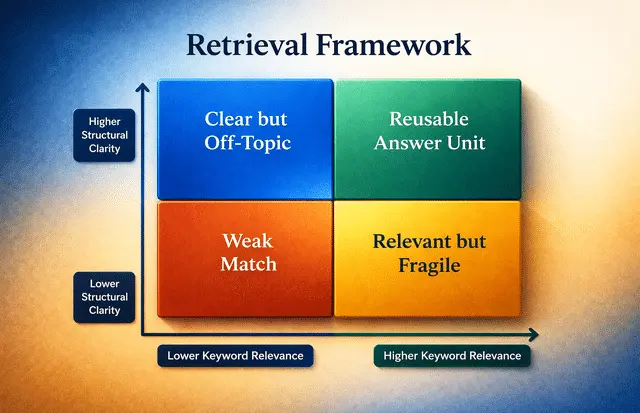
Retrieval depends on more than topic wording alone. For AI-facing systems, structural signals help determine whether a passage is easy to isolate, interpret, and reuse once a system identifies it as potentially relevant. Keywords still help connect content to a topic or query, but retrieval quality is also influenced by whether the page presents information in clearly bounded sections, stable conceptual units, and recognizable semantic relationships. That is why AI content structure beyond keywords matters even when keyword relevance remains essential.
A structurally clear page gives retrieval systems stronger signals about where useful information begins, what it is explaining, and how much surrounding context is required to preserve its meaning. A well-defined heading hierarchy, clean segmentation, and coherent content organization can make a passage easier to surface as a distinct answer unit rather than as an ambiguous fragment. This does not guarantee retrieval, and it does not override the importance of query alignment. It means that content structure for AI systems helps determine whether relevant information is packaged in a way that supports reliable extraction.
Relevance and retrievability are not identical. A passage may contain strong keywords and still be difficult to retrieve usefully if its role is buried inside a loosely organized section or mixed with multiple unrelated ideas. On the other hand, a passage with clear structural boundaries and strong topical framing is easier to interpret as a meaningful source unit once the system recognizes its relevance. In that sense, structured content for AI search helps convert topical language into more usable retrieval material without replacing the role of keywords themselves.
This is also where keyword limits become easier to understand. Keywords can suggest what the content is about, but they usually do not define passage boundaries, conceptual scope, or the structural relationship between one idea and the next. Structural clarity helps supply those missing signals. When content layout signals, semantic organization, and hierarchical markup are aligned with the actual meaning of the page, retrieval has a better chance of surfacing material that holds together under summarization or reuse.
The practical point is not that structure outranks keywords in every case. It is that retrieval works best when keyword relevance and structural clarity support one another. To understand how AI interprets content structure, recognize that keywords help identify subject matter, while structure helps shape whether that subject matter is retrievable as coherent, reusable information.
Why Extractable Sections Need Structural Independence
Extractable sections need structural independence because AI-facing systems often do not reuse an entire page at once. They may surface one section, one passage, or one tightly bounded answer unit. When that happens, the selected material has to preserve its meaning without relying too heavily on earlier or later sections to explain what it is doing. That is part of why content structure for AI systems is not only about organizing a full article. It is also about making sure individual sections can stand as clear source units when they are read out of sequence.
Structural independence is not the same as making every section read like a separate article. It means the section should define its own scope clearly enough that its main point survives partial reuse. A structurally independent section identifies its subject, maintains a stable conceptual boundary, and keeps its explanation tied to the exact role the section is meant to serve. In practice, that often depends on structural clarity, heading hierarchy, segmentation, and semantic organization working together so the section can be understood without excessive reconstruction from surrounding context.
Without that independence, extractability becomes weaker even when the content is accurate. A passage may contain useful information, but if it depends on earlier paragraphs to define the concept, qualify the claim, or establish what is being contrasted, the reused material can lose precision. That problem is common in AI content parsing because a system may retrieve a passage that is topically relevant while still missing part of the interpretive frame that originally gave the passage its intended meaning.
In citation-oriented content, that independence helps preserve source value under summarization, retrieval, and reuse. A clearly bounded section gives stronger signals about what claim or explanation belongs inside that section and what does not. That makes the material easier to interpret as a reusable source unit instead of a fragment that only makes sense inside the full article flow. AI content structure beyond keywords is stronger when each major section carries enough internal clarity to preserve meaning as a standalone explanatory unit within the larger article, which supports how AI interprets content structure under reuse.
How to Strengthen Content Structure for AI Interpretation
Strengthening content structure for AI interpretation starts with making each section carry a clear and limited role. A page becomes easier to interpret when its headings match the real scope of the material beneath them, related ideas are grouped together, and each section answers a recognizable subtopic instead of mixing definitions, contrasts, and qualifications into the same passage. It does not require writing for machines instead of people. It requires building content structure for AI systems in a way that makes context, boundaries, and priority easier to identify.
A practical way to improve how AI interprets content structure is to align hierarchy with meaning rather than with formatting habits. Main sections should cover genuinely major roles in the topic, while subordinate material should remain clearly subordinate instead of competing for equal weight. Segmentation should reflect conceptual divisions, not arbitrary visual breaks. Content organization should also follow the logic of the subject so that core ideas appear before narrower distinctions, examples, or implications. When heading hierarchy, segmentation, and information architecture reflect the actual shape of the topic, structural clarity improves without weakening readability.
It is also important to check whether individual sections can preserve meaning when read on their own. A section that depends too heavily on the surrounding article may still work for a full-page reader but perform poorly under retrieval or summarization. Stronger semantic content structure reduces that risk by giving each major section a stable subject, a clear explanatory job, and enough internal framing to remain understandable outside the full article flow. That is one of the most useful ways to improve AI interpretation without overstating what structure alone can do.
The goal is not to replace keywords, but to give them a more reliable framework for how AI interprets content structure. Keywords still help signal topic relevance, while AI content organization, heading hierarchy, and segmentation help show how that topic is shaped across the page. If you want to improve structured content for AI search, the most effective shift is usually not more keyword placement, but better alignment between meaning, section boundaries, and page-level organization.
AI-facing interpretation depends on more than whether the right terms appear on the page. It also depends on whether the page makes meaning easier to organize, separate, and reuse. When structure and keywords support one another, content becomes easier to interpret as coherent information instead of isolated language signals, which helps explain how AI interprets content structure.
Common Questions About How AI Systems Interpret Content Structure Beyond Keywords
Do keywords still matter if content structure is important?
Yes. Keywords still help signal topic relevance and connect a page to the language people and systems use to identify a subject. Content structure improves that signal by organizing the meaning around those keywords, clarifying context, scope, priority, and relationships between ideas.
Why does heading hierarchy affect how AI systems interpret content?
Heading hierarchy helps show which ideas are central, which ideas are supporting, and how sections relate to one another. When headings match the actual meaning of the content beneath them, AI systems have clearer signals for understanding context, topical priority, and section boundaries.
What makes a section more useful for AI retrieval or answer extraction?
A useful section has a clear topic, stable boundaries, and enough internal context to make sense when read outside the full article. When a passage can preserve its meaning on its own, it becomes easier to retrieve, summarize, and reuse without losing the point the article intended to communicate.