A Citation-Ready Content Checklist
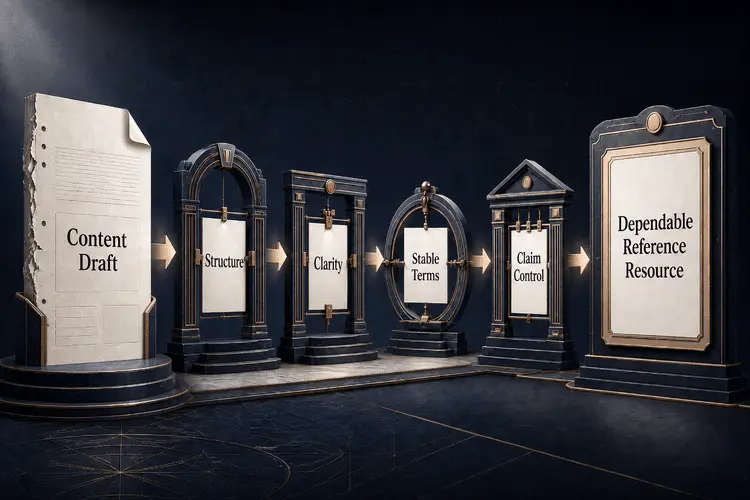
A practical citation-ready content checklist for evaluating whether content is structured, clear, and useful enough to function as a reliable reference resource.
A citation-ready content checklist is not a shortcut for adding more keywords, length, or broad topical coverage. Use it to assess whether a piece of content has enough structure, clarity, and reliability to function as a useful source beyond basic ranking visibility.
For content creators, site owners, and writers, the goal is to evaluate whether the page gives readers a clear reason to trust, understand, summarize, and reuse its explanations. Citation-ready content depends on strong definitions, organized information, low ambiguity, careful claims, and sections that can stand on their own without losing meaning.
What Citation-Ready Content Means
Citation-ready content is content that is organized and written well enough to function as a dependable reference point for a specific topic. It does not mean the content is guaranteed to be cited, quoted, ranked, or selected by any search engine or AI system. It means the content has the qualities a reliable source should have before it can reasonably support explanation, summarization, comparison, or reuse.
For a page to be citation-ready, it must do more than cover a topic broadly. It needs a clear purpose, stable terminology, useful definitions, logical section structure, and explanations that do not depend on vague claims or unsupported assumptions. A reader should be able to understand what the page clarifies, where its boundaries are, and why its explanations can be trusted within the scope of the topic.
This is where citation-ready content differs from ordinary optimized content. A page can be written for SEO and still be too thin, too ambiguous, or too promotional to work as reference-grade content. Content built to be cited must give human readers and AI-mediated systems enough structured information to identify the subject, interpret the claims accurately, and separate useful explanation from general commentary.
A practical citation-ready content checklist evaluates whether the content has that level of source utility. It looks at structure, clarity, definitions, explanation quality, extractable sections, claim discipline, and overall reference value before the page is treated as a reliable resource.
Why Source Usefulness Matters Before Citation Potential
Source usefulness is the first standard
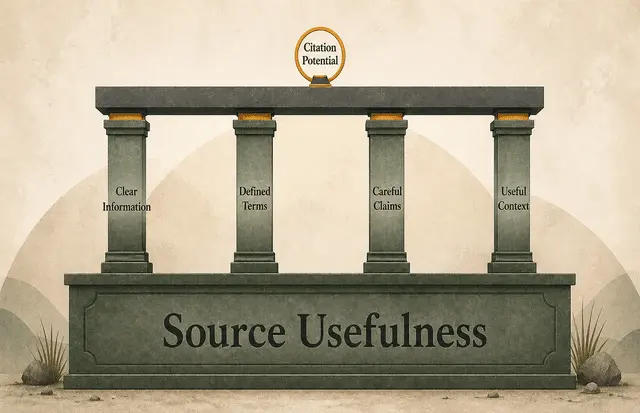
Before content can be evaluated for citation potential, it has to be useful as a source. Source usefulness means the page gives readers enough clear, specific, and reliable information to understand the topic without relying on unsupported claims, vague expertise signals, or general commentary. A useful source clarifies the subject, defines important terms, explains meaningful distinctions, and keeps its claims within the limits of what the content actually supports.
This matters because citation-ready content depends on substance before format. A page may have clean headings, visible keywords, and a professional layout, but still fail as reference-grade content if the explanations are shallow or unclear. Source utility comes from the page’s ability to answer a real informational need with enough precision that the explanation remains useful when summarized, compared, or read outside the full page.
Citation potential depends on usable information
Citation potential should be treated as a quality signal, not a promised outcome. Content becomes more suitable for reference use when it provides clear definitions, low-ambiguity explanations, careful claim framing, and enough context for a reader to understand what the content can and cannot support. These qualities make the content easier to interpret accurately, but they do not guarantee that any platform, search engine, or AI system will cite or select it.
A strong content citation checklist should therefore begin with usefulness rather than visibility. The first question is not whether the content looks optimized, but whether it gives readers a dependable explanation they can trust within the topic’s scope. When source usefulness is missing, citation-oriented content becomes little more than formatting around weak information.
How to Evaluate Content Structure for Reference-Grade Use
Content structure determines whether a page can be understood as organized information rather than a loose collection of related points. For reference-grade content, the structure should make the topic easy to follow from the first section through the final explanation. A reader should be able to see what the page is about, how each section contributes to the subject, and where to find a specific answer or clarification without sorting through unrelated context.
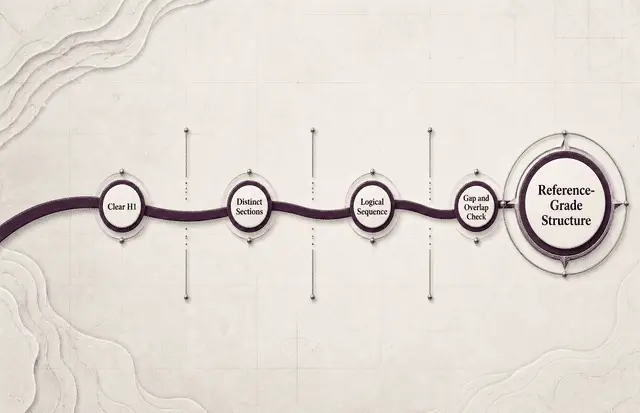
A strong structure begins with a clear H1, section headings that describe real subtopics, and paragraph development that stays aligned with each heading. Headings should not exist only to hold keywords or make the page look complete. Each section should carry a distinct informational role, such as defining a concept, explaining a distinction, clarifying a process, setting a boundary, or showing how the idea applies in practice.
Reference-grade structure also depends on clean sequencing. A page usually becomes easier to interpret when foundational ideas appear before deeper explanations, comparisons, limitations, or publishing decisions. If a section depends on a term, distinction, or assumption the page has not explained yet, the structure may create confusion even when the individual paragraphs are well written.
When evaluating content structure, look for gaps, overlaps, and misplaced ideas. A section is weak if it repeats another section’s purpose, combines too many unrelated ideas, or introduces important context too late for the reader to use it. Strong structured information gives the article a clear path, which helps the content function as a useful reference instead of a broad topical overview.
How to Check Definitions, Terminology, and Concept Boundaries
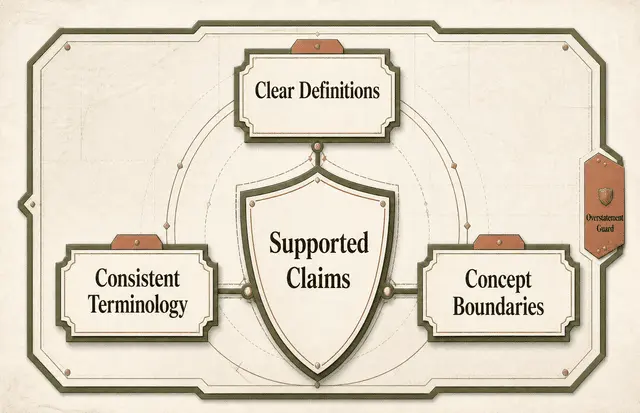
Clear definitions help citation-ready content establish what a concept means before the article begins using it as a working idea. If a page discusses reference-grade content, AI reference content, source usefulness, or extractable content without defining the terms well enough, readers may understand the general topic but miss the specific standard being applied. A definition does not need to be long, but it should be precise enough to guide the rest of the page.
Terminology must stay consistent
Terminology becomes weaker when a page uses several related phrases as if they all mean the same thing. For example, citation-ready content, citation-oriented content, and content built to be cited may be closely related, but the article should make their relationship clear instead of shifting between them without control. Consistent wording helps the reader follow the argument and helps each section reinforce the same core meaning.
This does not mean every term must be repeated in identical form. Natural variation is acceptable when the meaning remains stable. The problem appears when wording changes create uncertainty about whether the article is discussing structure, trust, extraction, summarization, ranking visibility, or actual citation outcomes. A citation-worthy content checklist should reduce that uncertainty instead of adding to it.
Concept boundaries prevent overstatement
Concept boundaries explain what the content is and is not claiming. A page can say that clear definitions, strong structure, and low-ambiguity content improve reference value, but it should not imply that those qualities guarantee citation, reuse, rankings, or inclusion in AI-mediated answers. The boundary matters because citation potential is not the same as a promised external result.
When checking this part of the content, look for places where the article uses broad language that may exceed what the page can support. Strong concept boundaries keep trusted content useful because they separate practical quality standards from claims about what another system, platform, or reader will do with the information.
How to Evaluate Explanation Quality and Standalone Value
Explanation quality is one of the strongest signals that content can function as a reliable reference resource. A section may mention the right terms and follow a logical outline, but still fail if it does not explain the subject clearly enough for a reader to understand the point, the context, and the limitation of the claim being made.
Strong explanations move beyond surface-level statements. They define the idea being discussed, show how it relates to the article topic, and give enough context for the reader to understand why the explanation matters. For citation-ready content, this is especially important because vague statements are difficult to summarize accurately and easy to misinterpret when separated from the full page.
Standalone value means a section or passage can still make sense when read on its own. This does not mean every paragraph must repeat the full article context. It means the passage should contain enough subject clarity, terminology, and claim framing that its meaning does not depend entirely on surrounding paragraphs. Standalone explanations are especially useful when a reader is scanning for a specific answer or comparing one source against another.
During review, check whether each explanation names the subject, clarifies the relationship being described, and states the limit of the point being made. If a paragraph sounds polished but does not help the reader make a more accurate judgment, it is not doing enough work for this article type.
How to Check Extractability, Summarizability, and Reuse
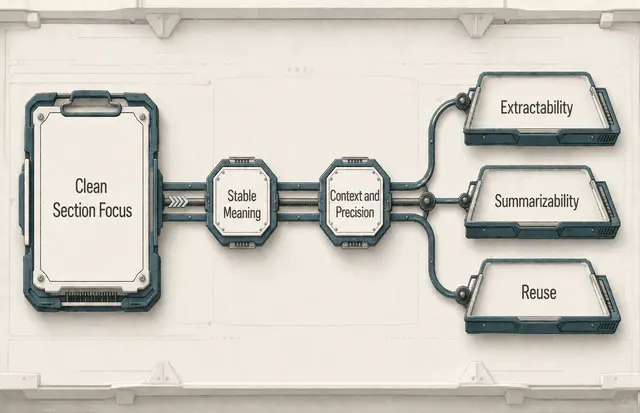
Extractability, summarizability, and reuse are related, but they are not the same standard. Extractable content is easy to identify and separate from the surrounding page. Summarizable content can be condensed without losing its central meaning. Reusable content contains enough context and precision that a passage can support explanation, comparison, or reference without becoming misleading.
Extractability depends on clean section focus
A section is easier to extract when it has one clear purpose and does not mix unrelated ideas in the same passage. If a paragraph defines citation-oriented content, shifts into SEO strategy, and then makes a claim about AI content reuse, the useful point becomes harder to isolate. Strong extractable content keeps each explanation close to the heading it supports.
Clear structure also helps prevent partial extraction from distorting the meaning. When a passage includes the subject, the claim, and the needed context together, it is less likely to be misunderstood when read outside the full article. This is especially important for content reliability because isolated claims can become weaker when the surrounding boundaries are missing.
Summarizability depends on stable meaning
Summarizable content does not need to be simplistic. It needs to be organized and precise enough that the main idea can be shortened accurately. A passage becomes difficult to summarize when it relies on vague wording, repeated qualifiers, unclear terms, or multiple ideas competing for the same paragraph.
Reuse depends on the same discipline. A reusable explanation should help someone understand the topic without requiring them to reconstruct the entire page. For a citation-ready content checklist, this means each major section should provide enough clarity, context, and boundary control to make the explanation useful beyond its original placement.
How to Evaluate Trust, Evidence, and Claim Discipline
Trust is not created by confidence alone. In citation-oriented content, trust depends on whether the page gives the reader enough support to understand why a statement is reasonable within the topic’s scope. A strong page does not need to overstate its authority, but it does need to separate clear explanation from assumption, opinion, and unsupported certainty.
Evidence should match the type of claim being made. Some claims need factual support, some need clear reasoning, and some need careful limitation language because the content is explaining a practical standard rather than proving a measurable outcome. When a page says content structure improves reference value, that claim should be framed as a quality and usability issue, not as a guaranteed path to citations, rankings, or AI inclusion.
Claim discipline means the article stays within what the content can responsibly support. Phrases that promise external results weaken content reliability because they shift the article from practical evaluation into prediction. A reference-grade content page should make careful claims about structure, clarity, definitions, ambiguity, and usefulness without implying control over how another system or reader will use the information.
Trustworthy framing also requires consistency. If one section treats citation-ready content as a publishing standard and another treats it as a performance tactic, the article creates confusion about its own purpose. The stronger approach is to keep the article grounded in content quality: what the page explains, how clearly it explains it, and whether its claims remain accurate when the content is summarized or reused.
How to Identify Ambiguity, Gaps, and Weak Reference Value
Ambiguity appears when content leaves too much room for the reader to guess what a statement means, what standard is being applied, or how one idea connects to another. In a citation-ready content checklist, ambiguity is a warning sign because unclear language makes the content harder to trust, summarize, or use as a dependable reference point.
Ambiguity weakens interpretation
Low-ambiguity content uses specific wording, stable terms, and clear relationships between ideas. If a page says content should be “high quality” or “optimized for AI” without explaining what those phrases mean in context, the statement does not provide much reference value. The wording may sound relevant, but the reader still has to supply the meaning.
Ambiguity also shows up when the article shifts between related concepts without explaining the difference. Citation-ready content, reference-grade content, answer-ready content, and AI reference content may overlap, but they should not be treated as interchangeable if the article uses them to describe different standards. Clear concept relationships help the reader understand what is being evaluated and why it matters.
Gaps and weak reference value limit usefulness
A content gap exists when the page raises an important idea but does not explain it well enough to support the article’s purpose. A section may mention trust, evidence, extractability, or content reliability, but if it does not explain how that quality is evaluated, the reader is left with a label instead of a usable standard.
Weak reference value usually comes from content that is too general to support a clear judgment. A page may be readable and relevant, but still leave the reader unsure about what standard was used, which claim is being made, or what evidence the explanation depends on. The problem is not the absence of length; it is the absence of usable meaning.
How to Use the Checklist Before Publishing
A citation-ready content checklist is most useful when it is applied before publication, not after the article has already been treated as complete. At that stage, the page can still be evaluated as a working resource instead of a finished draft that only needs light polishing. The review should focus on whether the content gives readers enough structure, explanation, context, and reliability to support informed use.
The checklist should be applied at the page level and the section level. At the page level, the content should have a clear purpose, a logical structure, consistent terminology, and a defined scope. At the section level, each major part should explain one meaningful subtopic, avoid unsupported claims, and provide enough context to remain understandable if a reader enters the article at that point.

Failed checks should guide revision
If a section fails a checklist item, the answer is not always to make the article longer. The better revision may be a clearer definition, a tighter heading, a more precise claim, a stronger distinction, or the removal of wording that creates confusion. Citation-ready content depends on useful information, not excess explanation.
The final review should also look for patterns across the full page. Repeated vague language, overlapping sections, inconsistent terms, and claims that exceed the article’s support can weaken the entire resource even when individual paragraphs read well. Those patterns should be repaired before publication because they affect how accurately the page can be read, summarized, and used.
Citation-ready content is built through deliberate editorial choices, not by adding a final optimization layer. A practical citation-ready content checklist keeps those choices visible before publication, so the finished page is clearer, more controlled, and more dependable for readers who need a reliable explanation.
Common Questions About Citation-Ready Content
How do I know if content is citation-ready before publishing?
Content is citation-ready when it has a clear purpose, logical structure, stable terminology, useful definitions, careful claims, and sections that can be understood without relying on the full article for context. The page should help a reader identify what is being explained, what the explanation supports, and where the content’s limits are.
Is citation-ready content the same as content that will be cited?
No. Citation-ready content means the page has the qualities of a dependable reference resource, but it does not guarantee that a search engine, AI system, publisher, or reader will cite it. The goal is to improve clarity, usefulness, extractability, and claim control so the content is better prepared for reference use.
What is the most common reason content fails a citation-ready review?
Content often fails because it sounds clear at a surface level but does not provide enough usable meaning. Weak definitions, vague claims, repeated ideas, inconsistent terminology, and unsupported statements can make a page harder to trust, summarize, or reuse as a reference resource.
What should I do if content fails part of the citation-ready checklist?
If content fails part of the checklist, revise the specific weakness instead of simply adding more text. The better fix may be a clearer definition, a more accurate heading, tighter terminology, stronger claim limits, or a section that explains one idea more completely. Citation-ready content improves when weak areas are repaired with precision, not when the article is expanded without purpose.