How AI-Driven Search Changes Long-Term Content Strategy
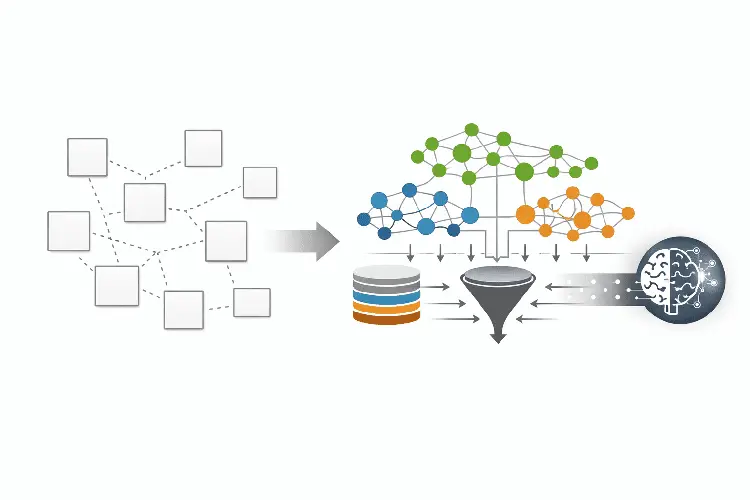
Content strategy used to focus heavily on individual pages, target keywords, and isolated ranking opportunities. That approach made sense when search visibility was tied more closely to how well a single page aligned with a specific query. As AI-driven search becomes more influential, that older model becomes less reliable. Content is no longer evaluated only as a collection of separate pages. It is increasingly understood in relation to surrounding content, site-wide relevance, topical depth, and the consistency of the overall content environment.
This changes what long-term content strategy needs to accomplish. Rather than treating content planning as a series of disconnected publishing decisions, you need to think more carefully about how content relationships, authority building, structural consistency, and long-term visibility development work together. An effective AI search content strategy depends less on chasing isolated opportunities and more on creating a durable publishing strategy that helps content remain useful, connected, and contextually strong within a broader site structure.
For businesses and content creators working in an AI-driven search environment, this shift matters because strong visibility increasingly comes from accumulated signals rather than single-page performance alone. Long-term content strategy now has to support content lifecycle planning, content clusters, and site-wide relevance in ways that align with generative search systems and AI Overviews. You need to understand that shift if you want to build a content strategy for AI search that can hold value over time.
Why AI-Driven Search Changes the Strategic Role of Content
AI-driven search changes the strategic role of content by reducing the importance of treating each page as a mostly independent ranking asset. Content still needs to be useful and relevant at the page level, but it is increasingly interpreted through wider contextual signals that shape how the page is understood within the larger site.
Under the older model, content planning often focused on individual targets, isolated optimization, and one-page performance. That logic encouraged businesses to judge success mainly by whether a single page aligned well with a specific query and could compete on its own.
That is no longer the full strategic picture. In an AI search content strategy, the value of a page depends not just on what it says by itself, but on how it contributes to content relationships, reinforces site-wide relevance, and supports a stronger topical environment across the full publishing structure.
As a result, long-term content strategy becomes more important than isolated optimization tactics. You need content planning that helps articles, service pages, and supporting resources work together as connected assets built around structural clarity and cumulative value.
How AI-Driven Search Moves Planning Beyond Page-by-Page SEO
Planning content one page at a time assumes that each page can be treated as a mostly independent asset. The goal in that model is straightforward: choose a target query, build a page around it, and improve that page’s ability to compete on its own. That logic still applies in some situations, but it does not fully match how AI-driven search connects and interprets information.
The planning unit is now broader. Instead of treating the single page as the main strategic object, you need to plan around topic development, supporting relationships, and the role each piece plays inside a larger content environment. A page might establish a concept, deepen context, or strengthen site-wide relevance by covering a closely related angle. The planning decision is no longer just whether a page is well optimized, but whether it helps create a stronger body of content overall, much like the structured publishing model explained in how one SEOBoostAI article is built through a repeatable workflow.

That shift changes what long-term content strategy is trying to produce. A business is not simply building separate pages for separate opportunities. It is building content clusters, clearer contextual pathways, and a publishing structure that helps search systems interpret expertise over time. In that kind of AI search strategy, page-level SEO still matters, but it becomes part of a broader content planning model rather than the full strategy by itself.
Why Content Relationships Matter in AI-Driven Search
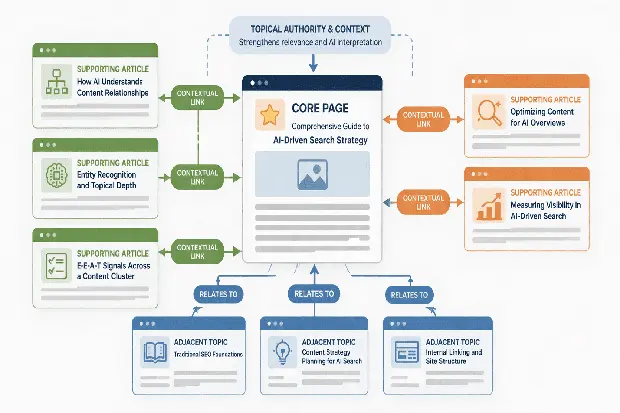
Content relationships matter because AI-driven search interprets pages with more confidence when they sit inside a connected body of relevant material. A strong page can still be useful on its own, but it becomes easier to understand when surrounding content helps define its context, role, and topical fit.
How relationships strengthen interpretation
When a page is supported by related explanations, adjacent topic coverage, and clearly connected articles, search systems gain more context for understanding what that page contributes. That broader environment helps clarify whether the site shows meaningful coverage or only isolated relevance.
Why this changes content planning
This is why content strategy for AI search has to focus on more than page quality in isolation. Strong relationships between pages can improve topical clarity, reinforce site-wide relevance, and make the content environment easier for generative search systems to interpret as a coherent source of information.
The larger issue is not whether every page links everywhere else. It is whether related content has been developed with enough planning and consistency to support one another over time. When that happens, connected publishing can contribute to stronger topical authority, better content lifecycle planning, and more durable search visibility, especially when it reflects how authority is evaluated across the modern search environment.
How Topical Authority Accumulates Through Long-Term Content Development
Topical authority is cumulative. It forms when a site continues to develop relevant coverage in ways that show depth, continuity, and real commitment to the subject over time, rather than relying on one successful page to carry the topic alone.
Why authority builds gradually
Authority building depends on sustained development rather than isolated output. A site may begin by introducing a concept, then expand it, and later clarify related issues that strengthen the overall topic footprint. As that body of content grows, search systems have more evidence for understanding what the site reliably covers and how strongly that coverage holds together.

What turns more content into stronger authority
More pages do not automatically create stronger topical authority. Repetition alone does not strengthen it. The content has to extend the topic in useful ways, create stronger content relationships, and support content lifecycle planning instead of producing slight variations of the same page.
When that continuity is present, topical authority becomes the result of connected, deliberate growth rather than the temporary success of a single piece of content, which also helps explain how authority signals are interpreted in AI-driven search systems.
Why Structural Consistency Matters Across the Content Environment
Structural consistency helps search systems and readers make better sense of everything around the page, not just the page itself. In an AI-driven search environment, that matters because related content becomes easier to interpret when it is presented within a stable, recognizable framework.
What structural consistency actually supports
It supports interpretability across the site. When similar content types follow clear hierarchy, stable organization, and comparable development patterns, related pages feel connected rather than accidental. That consistency does not require identical formatting, but it does require enough shared structure that topic relationships and site-wide relevance are easier to detect.
What happens when that consistency is missing
When structure changes too sharply from one page to another, the content environment can feel fragmented even if the information itself is useful. Search systems have a harder time recognizing recurring subject treatment, and readers lose some of the predictability that helps them move confidently through related material. That is why structural consistency matters across the content environment rather than only within one page at a time, which also connects to what content trust means in modern search.
How AI-Driven Search Changes the Long-Term Publishing Value of Content
Not every valuable page proves its worth the same way. In an AI-driven search environment, publishing value is no longer measured only by whether one page wins visibility for one target term within a short time window.
A page may create immediate value through direct performance. It may also contribute more indirectly by strengthening a topic cluster, adding contextual support, or helping search systems interpret the broader content environment with more confidence. That means a page can justify its place through the role it plays inside the larger publishing system, not just through isolated rankings.
This changes how you should evaluate content decisions over time. Long-term content strategy has to account for pages that extend topical depth, reinforce content relationships, and improve search visibility gradually rather than instantly.
When publishing value is understood that way, content becomes less like a sequence of separate performance bets and more like a collection of durable assets that strengthen the larger strategy from different angles and on different timelines, including the kinds of risks outlined in the long-term risks of publishing AI-generated content at scale.
What Businesses Need to Prioritize in an AI-Driven Search Environment
Priority one: build connected content, not isolated pages
Businesses need to prioritize durable content planning over isolated publishing decisions. In an AI-driven search environment, short-term page targeting is not enough to support strong long-range visibility. Content strategy needs to focus on how pages connect, how topic coverage expands over time, and how the overall content environment supports clearer interpretation of relevance, expertise, and usefulness.

Priority two: publish in ways that strengthen the larger system
Connected content development, stronger site-wide relevance, and a publishing strategy that builds cumulative value matter more than scattered wins. You should think in terms of content clusters, structural consistency, and content lifecycle planning so each new piece strengthens the larger system rather than standing apart from it. That kind of planning improves topical clarity and supports long-term search visibility.
For beginner and intermediate content teams, this shift changes what successful planning looks like. A strong AI search content strategy depends less on individual pages competing alone and more on whether the broader content structure creates a useful, coherent, and trustworthy environment around the topic, which is closely related to why content optimization has changed from SEO to GEO.
When businesses prioritize that kind of long-term development, they are better positioned to build lasting visibility as AI-driven search continues to evolve.
Common Questions About AI-Driven Search Content Strategy
Why are isolated pages less effective in AI-driven search?
Isolated pages are less effective because AI-driven search systems interpret content in relation to the broader site environment. A single page can still perform well, but it becomes stronger when related articles, consistent structure, and connected topic coverage help clarify its role, relevance, and usefulness.
How can a business tell whether a new article supports long-term content strategy?
A new article supports long-term content strategy when it adds useful depth, strengthens an existing topic cluster, answers a distinct reader need, or improves the site’s overall topical clarity. It should not simply repeat an existing page or target a keyword without improving the larger content environment.
Does every article need to show immediate rankings to be valuable?
No. Some articles create value by supporting related pages, expanding topical authority, or helping search systems better understand the site’s coverage over time. Immediate rankings can matter, but long-term value also comes from how well a page strengthens the broader publishing strategy.