A Prompt Workflow Quality Checklist
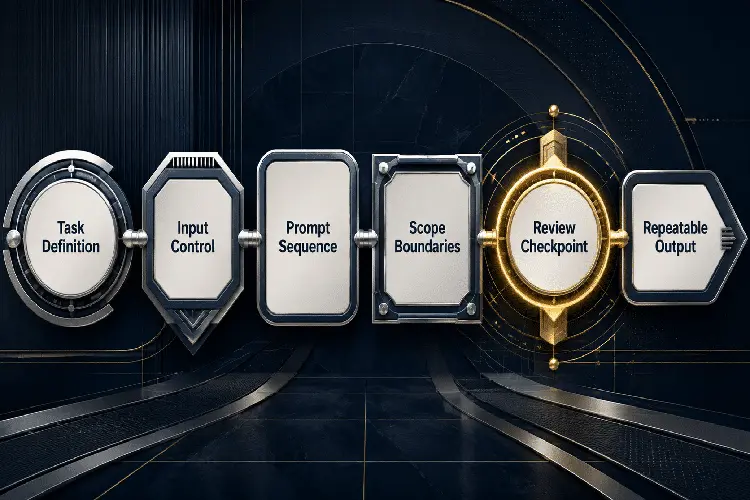
A practical checklist for reviewing whether a prompt workflow is clear, controlled, and ready to produce repeatable AI outputs.
A prompt workflow quality checklist checks whether an AI prompt workflow has enough structure to guide a task from input to output without relying on guesswork. For beginners, this means looking beyond the wording of a single prompt and reviewing the full prompt sequence, the required inputs, the expected output format, and the checkpoints that keep the workflow controlled.
A reliable prompt workflow should make the task clear, define what information is needed, limit unnecessary scope changes, and support a repeatable review process. When prompt workflow design is handled carefully, structured prompting becomes easier to test, adjust, and reuse across similar tasks.
What a Prompt Workflow Quality Checklist Evaluates
A prompt workflow quality checklist reviews the workflow around a prompt, not just the prompt text itself. It checks whether the task has a clear starting point, complete input requirements, a logical prompt sequence, a defined output format, and a review process that can catch problems before the work is accepted.
Workflow readiness
The checklist evaluates whether each part of the workflow gives the AI system enough direction to complete the task within the intended scope. This includes the instructions that define the task, the limits that prevent unnecessary expansion, and the approval checkpoints that separate drafting, review, revision, and final acceptance.
Repeatable use
A prompt workflow checklist also evaluates whether the process can be reused for similar work without being rebuilt each time. A repeatable prompt workflow should make the required inputs clear, preserve the order of execution, and produce an output that matches the intended format without depending on guesswork or informal correction.
This type of review is especially useful for beginners because it separates a well-written prompt from a controlled AI prompt workflow. The main question is not whether the prompt sounds clear in isolation, but whether the full workflow gives enough structure for consistent execution.
Why Prompt Workflow Quality Matters for Reliable AI Results
Reliable AI results are easier to produce when the workflow controls how the task is started, developed, reviewed, and accepted. Without that control, the AI may still respond fluently, but the result can depend too heavily on assumptions that were never defined in the prompt workflow.
This matters because many prompt failures are workflow failures, not wording failures. The prompt may ask for the right deliverable, but the process may leave out the required inputs, skip the review stage, provide no revision boundary, or fail to define the final output format. Those gaps make the result harder to repeat because the AI system has to fill in too many missing decisions.
For beginners, the practical value of a structured workflow is that it makes problems easier to locate. If the output is wrong, check whether the issue came from missing context, unclear instructions, weak scope control, poor sequencing, or an incomplete review process.
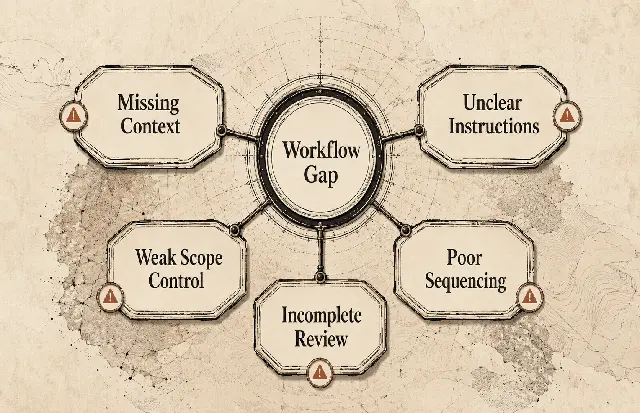
A repeatable prompt workflow gives the task a stable path. Each step has a purpose, each input has a reason, and each approval checkpoint prevents the work from moving forward before the current part is ready. That structure is what helps prompt workflow design produce more dependable results across similar tasks.
Prompt Structure and Instruction Clarity
Prompt structure is the way instructions are arranged so the AI system can understand the task, limits, and expected result. A clear structure separates the main objective from supporting details, which reduces the chance that important requirements will be missed or treated as optional.
Instruction clarity means the prompt says what should happen without relying on hidden assumptions. A workflow is weaker when instructions are broad, vague, or mixed together in a way that makes the task hard to follow. For example, asking for an article, a review, a rewrite, and a final version in the same prompt may create confusion if the workflow does not define the order of those actions.
Clear task direction
A strong prompt workflow should make the primary task easy to identify. The AI system should be able to tell whether it is generating content, reviewing content, revising content, formatting content, or waiting for approval. When the task direction is not clear, the output may combine actions that should have remained separate.
Readable instruction order
The order of instructions also matters. Requirements that control scope, format, inputs, and review should be placed where they can guide the task before output begins. If the workflow gives important rules too late, or scatters related rules across unrelated sections, the prompt sequence becomes harder to follow and harder to reuse.
For a prompt workflow quality checklist, this section should confirm that the prompt structure supports controlled execution. The workflow should not depend on the AI system guessing which instructions matter most, which action comes first, or what format the final output must follow.
Input Requirements and Context Control
Input requirements define what information must be provided before the prompt workflow can produce a useful result. In a controlled workflow, the AI system should not have to guess the topic, audience, format, constraints, source material, approval status, or task objective. Those details need to be stated clearly enough that the task can begin from a stable point.
Context control limits what the AI system is allowed to use when completing the task. This matters because extra assumptions can change the output, especially when the workflow involves writing, reviewing, revising, or formatting content. A prompt may be clear about the desired result, but still weak if it does not define which inputs are authoritative and which information should be ignored.
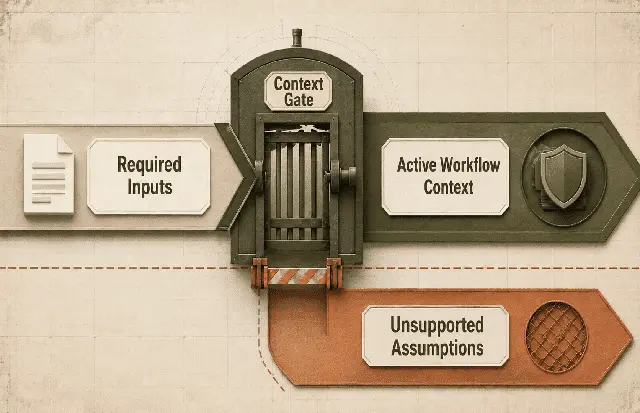
A practical prompt workflow checklist should verify that required inputs are separated from optional details. Required inputs are the details the workflow cannot operate without. Optional details may help improve accuracy, tone, or formatting, but they should not replace the core information needed to complete the task.
Good context control also protects the workflow from scope drift. If the prompt sequence does not define what the AI system should use, avoid, preserve, or wait for, the output may include assumptions that were never approved. For repeatable work, the workflow should make the active context clear before any content is generated or revised.
Prompt Sequence and Workflow Order
Prompt sequence is the order in which workflow instructions are given and executed. In a structured prompting process, sequence matters because each step depends on the step before it. If the workflow asks for review before content exists, revision before approval, or final formatting before the content is stable, the process becomes harder to control.
Step order
A clear prompt sequence shows what should happen first, what should happen next, and when the AI system should stop. This is especially important when the workflow includes multiple actions, such as generating, reviewing, revising, and approving content. Each action needs its own place in the workflow so the AI system does not combine steps that should remain separate.
Execution control
Workflow order also affects how much control the user has during the process. Approval checkpoints are most useful when they appear before the next major action begins. If a workflow moves forward without confirming that the current step is complete, errors can carry into later sections and become harder to correct.

A repeatable prompt workflow should make the path of execution clear enough that the same process can be followed again with new inputs. The stronger the order, the easier it is to identify where a task is, what has already been approved, and what still needs to happen before the final output is accepted.
Output Format, Scope Control, and Approval Checkpoints
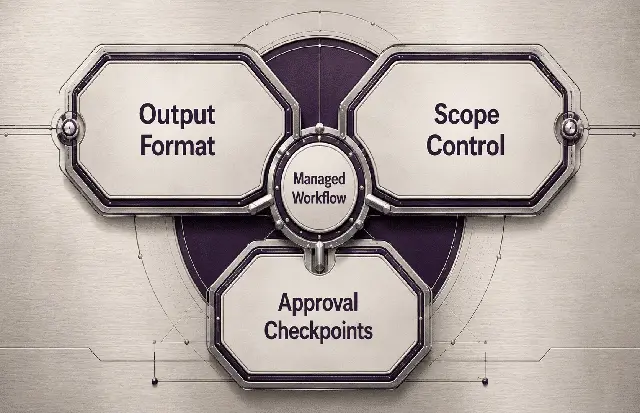
Output format, scope control, and approval checkpoints are three separate controls that keep a prompt workflow from becoming too loose. Output format defines how the result should be delivered, scope control defines what the AI system is allowed to include, and approval checkpoints define when the user must confirm that a step is ready before the workflow continues.
Output format
A clear output format tells the AI system what the finished response should look like. For example, a workflow may require clean HTML, plain text, a table, a short draft, a full section, or a specific sequence of fields. If the format is not defined, the AI system may still answer the task, but the result may not be usable without extra correction.
Scope control
Scope control prevents the workflow from expanding beyond the approved task. A prompt should make clear what can be changed, what must be preserved, and what should not be included. This is especially important when the workflow involves revisions, because an uncontrolled revision can alter content that was already approved or introduce new material that does not belong in the current step.
Approval checkpoints
Approval checkpoints give the workflow a stopping point between major actions. They separate drafting from review, review from revision, and revision from final acceptance. Without checkpoints, the AI system may continue into the next step before the current output has been checked.
For a prompt workflow quality checklist, these controls show whether the process is managed from start to finish. The workflow should define the expected output, keep the task inside its intended boundaries, and require approval before moving into the next major action.
Quality Control and Review Process
Quality control is the part of a prompt workflow that checks whether the output actually matches the task. It should confirm that the result follows the approved instructions, uses the required inputs, stays within scope, and matches the expected output format. Without this step, a workflow may produce content that looks complete but still misses important requirements.
The review process should be specific enough to catch real problems. A weak review only asks whether the result looks good. A stronger review checks whether the output is accurate to the provided context, complete within the approved scope, consistent with the intended audience, and free from unnecessary additions.
For repeatable work, quality control should happen before final approval, not after the workflow has already moved forward. This gives the user a clear point to identify missing information, structural problems, formatting errors, or instructions that were not followed. It also keeps revisions focused because the workflow can correct the current step before later steps are affected.
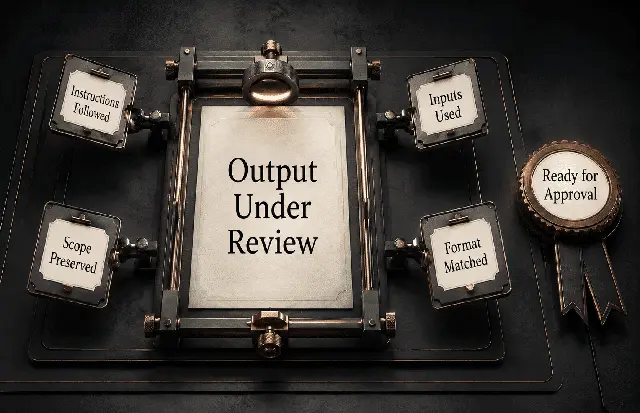
A prompt workflow checklist should treat review as part of the workflow, not as a separate afterthought. The review process gives the workflow a practical way to confirm that the output is usable, controlled, and ready for the next step.
Signs a Prompt Workflow Is Ready to Reuse
A prompt workflow is ready to reuse when it can guide the same type of task again without needing the user to rebuild the process from scratch. The workflow should have a clear purpose, stable input requirements, a defined prompt sequence, and an output format that can be applied consistently to similar work.
Stable execution
Stable execution means the workflow does not depend on informal corrections, hidden assumptions, or one-time explanations that are not written into the prompt sequence. A reusable workflow should tell the AI system what to do, what to avoid, when to stop, and how the finished output should be delivered.
Controlled review
A ready workflow also includes a review process that can be repeated. You should be able to check whether the output followed the instructions, stayed within scope, used the required inputs, and met the expected format before approval. If revisions are needed, the workflow should keep those revisions limited to the current task instead of changing already approved material.
The strongest sign of readiness is that the workflow can be tested with new inputs and still produce a controlled result. A prompt workflow checklist should confirm that the process is clear enough for repeated use, complete enough to reduce avoidable correction, and structured enough to keep the task moving in the right order.
A strong prompt workflow is not just a better-written prompt. It is a controlled process that defines the task, gathers the right inputs, guides the sequence, protects the scope, and checks the output before the work is accepted. When those pieces are in place, structured prompting becomes easier to repeat and easier to improve over time.
Common Questions About Prompt Workflow Quality
What is the difference between a prompt and a prompt workflow?
A prompt is a single instruction or request given to an AI system. A prompt workflow is the larger process around that instruction, including the required inputs, the order of steps, the output format, review points, revision rules, and approval checkpoints that guide the task from start to finish.
How can you tell if a prompt workflow is too vague?
A prompt workflow is too vague when the AI system has to guess important details such as the topic, audience, format, task limits, source material, or approval status. If the same task produces inconsistent results because the workflow does not define what should happen next, what should be preserved, or when the process should stop, the workflow needs stronger structure.
Why are approval checkpoints important in a prompt workflow?
Approval checkpoints prevent the workflow from moving forward before the current step is ready. They give you a clear place to review the output, identify missing information, request focused revisions, and keep later steps from being built on unresolved problems.